[email protected]
+1 (502) 904-2126
One Westbrook Corporate Center, Suite 300, Westchester, IL 60154, USA
Site Map
 ISSN: 2574 -1241
Received: October 01, 2026; Published: October 15, 2026
*Corresponding author: Emin Taner ELMAS, Assistant Professor, Vocational School of Higher Education for Technical Sciences, Division of Motor Vehicles and Transportation Technologies, Department of Automotive Technology, Iğdır University, Turkey & Graduate School of Natural and Applied Sciences - Major Science Department of Bioengineering and Bio-Sciences, Iğdır University, Turkey Iğdır University, 76000 Iğdır – TURKEY
DOI: 10.26717/BJSTR.2026.67.010442
Objective: This study presents an interdisciplinary framework that autonomizes the thermal management of
high-temperature laser ablation and ultra-low-temperature cryoprobe applications, which represent opposing
thermal poles in robotic neurosurgery operations. The thermal sensitivity of neural tissues and the risk of permanent
neuron damage developing at temperatures above 43°C necessitate a micron-level stable thermal control.
Accordingly, the study aims to optimize surgical robots both in terms of hardware and software.
Method: The theoretical foundation of the study is based on the principles of “ELMAS’s Thermodynamic Theory”,
the “5th Law of Thermodynamics”, and “Bio-Robotic Resonance” developed by Asst. Prof. Dr. Emin Taner
Elmas. In the hardware layer, dual-phase medical heat pipes integrated into the tip of the robotic arm (end-effector),
having a diameter of 0.8 mm, flexible, and containing sintered copper powder micro-capillaries with
water-graphene nano-fluid, were utilized. In the software layer, an embedded artificial intelligence (AI) engine
supported by machine learning models was developed, capable of real-time data processing from micro-sensors
on the heat pipe and performing digital twin-based live thermal mapping (HUD). The validation of the system
was designed with a 5-step validation protocol encompassing computerized thermal modeling, synthetic gel
tests, ex-vivo organ tests, in-vivo animal experiments, and preclinical human simulation.
Findings: The integration of the micro-heat pipe provided passive cooling without requiring an external energy
source, thereby suppressing peripheral heat dissipation (thermal dissipation) during laser operations and
maintaining healthy neural tissues within a stable range of 37°C - 38°C. In cryoprobe applications, it acted as a
passive heat barrier, creating reverse thermal gradients along the probe shaft, protecting healthy tissues along
the entry path while performing instantaneous shock freezing cycles (freeze-thaw) at the target tumor site.
The predictive algorithms of the AI engine predicted the thermal saturation at the tissue border milliseconds in
advance and successfully activated the haptic lock (fail-safe) mechanism that applies resistance to the surgeon’s
master control arms at critical thresholds.
Conclusion: The developed autonomous thermal management architecture elevates surgical robots beyond being
merely devices that produce mechanical motion into intelligent protective shields that thermally sense the
tissue. The integration of Dr. Elmas’s medical thermodynamics equations into robotic software demonstrates at
a preclinical level that a micron-level precise, autonomous, and thermally safe hybrid surgical platform can be
established for brain tumor resections. [1-111]
Keywords: Robotic Neurosurgery; Medical Heat Pipes; Elmas’s Theory of Thermodynamics; Fifth Law of Thermodynamics, Embedded AI; Bio-Robotic Resonance; Thermal Management Systems; Laser Ablation Cooling; Neuro-Cryoprobe; Haptic Fail-Safe Control
Neurosurgery is one of the most critical surgical branches requiring micron-level anatomical precision, where even the smallest mistake made during an operation can lead to permanent neurological deficits or mortality in the patient. Today, robotic surgery systems offer mechanical advantages such as filtering the surgeon’s hand tremors, high-resolution 3D imaging, and multi-axis mobility (degree of freedom) in deep tissues, thereby increasing the success rate in brain tumor resections. However, in contrast to this revolutionary development in the mechanical capabilities of robotic instruments, the control and management of thermal energy generated during operational processes still remain a fundamental problem waiting to be solved. Brain tissue and the components of the central nervous system are cellular structures with the highest sensitivity to temperature changes in the body. Every thermal fluctuation above physiological limits threatens cellular integrity; indeed, a temperature rise to 43°C and above in neural tissues causes irreversible protein denaturation, cellular necrosis, and permanent neuron loss within seconds. High-frequency electrocauteries and fiber-optic laser systems (e.g., CO₂ or Nd:YAG), which are frequently used in modern neuro-oncology surgeries to vaporize (ablate) or cut tumor tissue, generate local heat reaching thousands of degrees Celsius at the target point. The uncontrolled thermal energy released during this process spreads to neighboring healthy brain tissues via radiation and conduction (thermal dissipation), causing deep tissue damage beyond the surgical margin.
Similarly, in cryosurgery (cryoprobe) applications used for treating deep-seated lesions and aiming to destroy tissue by freezing it between -40°C and -160°C, when the volumetric boundaries of the iceball cannot be controlled millimetrically, critical vascular structures and functional nerve pathways (motor/speech centers) surrounding the tumor are subjected to freezing damage.Existing surgical robotic platforms lack the ability to monitor, evacuate, or autonomously limit heat flow at these opposing thermal poles (extreme hot and extreme cold) in real time. Traditional water-cooled lines, on the other hand, restrict the micro-joint flexibility of robotic arms due to their thick hose structures and additional hardware weight, carry infection risks, and fail to meet the micron-level miniaturization requirements needed by neurosurgery. This situation necessitates the transformation of surgical robots from being mere mechanical guides into intelligent thermal protection shields that can sense and manage heat. In this study, to bring a radical and holistic solution to the thermal management crisis in robotic neurosurgery, an autonomous surgical platform architecture is proposed that combines flexible micro-heat pipes in the hardware layer and embedded artificial intelligence (AI) algorithms in the software layer.
The theoretical and practical foundations of this proposed system are based on “ELMAS’s Theory of Thermodynamics”, the “5th Law of Thermodynamics”, and “Bio-Robotic Resonance” approaches, which blend human physiology with engineering principles, introduced to the literature by Asst. Prof. Dr. Emin Taner Elmas. This interdisciplinary vision, which treats the human body as a complex and dynamic “bio-machine”, brings a new dimension to the applications of dual-phase heat transfer mechanisms in medical technology. Within the scope of the developed framework, the water-graphene nano-fluid micro-heat pipes with a diameter of 0.8-1.2 mm positioned at the tip of the robotic arm (end-effector) passively remove excess heat from the surgical bed within milliseconds without requiring an external energy source, or protect healthy neurons by creating a dynamic thermal isolation barrier along the cryoprobe shaft. Simultaneously, the embedded AI engine, which incorporates Elmas’s thermodynamic equations into its core software, processes instantaneous temperature and heat flux data coming from micro-sensors to present the surgeon with a live thermal map (Thermal Overlay) on a 3D screen and autonomously activates haptic brake (fail-safe) protocols that prevent the surgeon from making mistakes at critical thresholds.
In this paper, the micro-hardware optimization, software, and AI architecture of the proposed intelligent thermal management system will be detailed; a 5-step experimental validation protocol extending from computerized modeling to preclinical human simulation will be presented for the system’s verification. In light of the findings obtained, it will be discussed how Dr. Elmas’s medical thermodynamics and bio-engineering studies form a strong academic and technical foundation for future AI-supported and tissue-sensitive safe robotic surgery platforms. [1-111]
The interdisciplinary studies of Asst. Prof. Dr. Emin Taner Elmas in the fields of medical technique and bio-engineering can be directly used in and contribute to robotic surgery technologies at both theoretical and practical levels. The approaches of Dr. Elmas, who is a senior mechanical engineer and an expert in energy transfer and thermodynamics, treating the human body as a “bio-machine”, hold significant potential for the hardware and software development of surgical robots. The main areas where his work can be integrated into robotic surgery are as follows: [1-111]
Bio-Robotic Resonance and Precision Control Algorithms
The “Bio-Robotic Resonance” and frequency-resonance adjustment theories developed by Emin Taner Elmas on cancer and other chronic diseases can be adapted to the operating principles of surgical robots. Use in Robotic Surgery: This theory can be utilized in developing intelligent control algorithms that dynamically optimize the force and precision (haptic feedback) applied by robotic surgical arms while touching tissue according to the natural vibration frequency of the tissue.
Medical Heat Pipes and Thermal Management Systems
Dr. Elmas has studies on the applications of medical heat pipes in medical technique within the framework of the “5th Law of Thermo dynamics” and the “ELMAS Thermodynamic Theory”. Use in Robotic Surgery: These thermodynamic approaches can be directly utilized in designing critical micro-cooling and precision thermal management systems at the tips of energy-generating and heat-emitting surgical instruments such as lasers, electrocauteries, or cryoprobes used in robotic surgery systems. In this way, thermal damage to healthy tissues during surgery can be prevented.
Bionic and Bio-Mechanical Modeling
The author has mechanics-oriented studies such as hip prosthesis bio-mechanics, artificial heart designs, and transtibial prosthesis analyses for runners. Use in Robotic Surgery: These bio-mechanical modelings can form a fundamental input in the design of mechanical joints of robotic surgery consoles and patient-side modules that are fully compatible with human anatomy and possess higher mobility (degrees of freedom).In summary; Emin Taner Elmas’s Medical Thermodynamics and bio-engineering studies, which adapt engineering principles to human physiology, offer a strong academic and technical infrastructure for the development of future artificial intelligence- supported, more tissue-sensitive, and thermally safer robotic surgery systems. The engineering approaches developed by Asst. Prof. Dr. Emin Taner Elmas on heat pipes and dual-phase heat transfer mechanisms can be directly used in the thermal management of robotic surgery systems, cooling of precision surgical instruments, and cryosurgery applications. The medical heat pipes examined by Dr. Elmas within the framework of the ELMAS Thermodynamic Theory and the 5th Law of Thermodynamics can be integrated into the following critical areas in robotic surgery: [1-111]
Thermal Management of Robotic Surgical Tips (End-Effector): Lasers, ultrasonic cutters, or high-frequency electrocauteries used in robotic surgery generate intense heat during operations.
• Passive Cooling: The feature of heat pipes to remove heat from the sensitive region passively (without needing an external energy source) prevents the tip portions of robotic arms from overheating.
• Tissue Safety: The dissipation of excess generated heat to healthy tissues is prevented, thereby increasing surgical precision and patient safety.
Cryosurgery and Cryoprob Efficiency: The dual-phase heat transfer systems addressed by Dr. Elmas within the scope of his Medical Heat Pipes Study play an active role in cryosurgery operations.
• Precise Temperature Control: The execution of instantaneous and controlled cooling/heating cycles by cryoprobes on the target tumor or diseased tissue can be optimized with heat pipe technology.
• Robotic Integration: Cera-surgical safety can be maximized by maximizing the thermal conductivity coefficient of flexible or mini cryoprobes managed from the robotic surgery console. Compact and Lightweight System Design: Robotic surgical arms have strict weight and volume constraints; heavy cooling mechanisms restrict the mobility of robotic arms.
• Micro-Scale Solutions: Heat pipes designed at the micro- scale provide high thermal conductivity without bringing an additional load to the joint structure of robotic arms.
• Device Lifespan: Keeping internal electronic components and motor drivers at optimum temperature reduces the risk of failure and extends the lifespan of robotic systems.
The thermodynamic approaches and medical heat pipe theory of Asst. Prof. Dr. Emin Taner Elmas can radically increase the efficiency and safety of both high-temperature-producing laser cutting systems and ultra-low-temperature-operating cryoprobes in robotic surgery.
Table 1: Robotic Surgery Heat Pipe Integration: Laser vs. Cryoprob.

How heat pipes can be integrated into two opposite thermal poles is summarized in the table and detailed analysis below:
Integration with Laser Cutting Systems (Heat Dissipation and Tissue Protection): Fiber optic lasers integrated into the tips of surgical robots can generate local heat reaching thousands of degrees Celsius while cutting or burning tissue. The ultra-high thermal conductivity of heat pipes comes into play at this point: [1-111]
• Prevention of Peripheral Thermal Damage: Healthy tissues right next to the point hit by the laser beam can be damaged due to radiation and heat dissipation. Micro-heat pipes to be placed at the very tip of the robotic arm (end-effector) absorb this excess heat away from the surgical bed within milliseconds.
• Continuous Focusing and Lens Safety: Optical lenses in the laser head can expand due to heat and disrupt the surgical focus. Heat pipes keep the lens periphery at a stable temperature, allowing the robot to make micro-level precise cuts throughout the surgery.
• Miniaturization (Scaling Down): Traditional water-cooled laser lines require thick hoses and restrict the degrees of freedom (mobility) of the robotic arm. The closed-circuit passive heat pipes in Elmas’s theory perform cooling without loading extra volume or weight onto the robotic arm.
Integration with Cryoprob Systems (Ultra-Fast Volumetric Freezing): Cryosurgery aims to destroy diseased or tumor tissues by freezing them between -40°C and -160°C. Heat pipe technology provides the following advantages in cryoprobes managed by robotic arms:
• Superconducting Heat Extraction: To destroy cells, the freezing process must occur very rapidly (in slow freezing, cells can protect themselves). Heat pipes performing dual- phase heat transfer extract heat from the target tissue at tremendous speed, creating instantaneous shock freezing cycles (freeze-thaw cycles).
• Dynamic Thermal Shaft Isolation: Only the very tip (needle) of the cryoprobe needs to be freezing, while the healthy organ pathways through which the probe passes must remain warm. Heat pipes act as an “intelligent heat barrier” by creating reverse thermal gradients along the probe shaft. Thus, only the tumor targeted by the robot freezes; the entry path is not damaged.
• Rapid Thawing Mode: After the tumor is frozen, the tip must be warmed rapidly for the probe to separate safely from the tissue. Thanks to the bidirectional operating capability of the heat pipe (interchanging roles of evaporator and condenser), the tip is brought to thawing temperature within seconds with a micro-heating signal sent from the robot.
Within the framework of Dr. Emin Taner Elmas’s bio-engineering vision, these two systems can be combined into a single “Hybrid Robotic Surgery Platform”. The robot can cut and clean the tumor with a laser within the same surgical operation while freezing microscopic cell remnants at the border zones with a cryoprobe. Thermal stability at both ends will be provided by micro-heat pipes based on Elmas’s theory. Integrating thermal management hardware (heat pipes) with the artificial intelligence (AI) and control software of surgical robots elevates operations to the level of “autonomous thermal safety”. Dr. Emin Taner Elmas’s Bio-Robotic Resonance and intelligent system approaches can serve as a bridge in transferring real-time data from physical heat pipes to software algorithms. This integration provides surgical robots with the following AI-supported capabilities during laser cutting and cryoprobe processes: [1-111]
AI-Supported “Thermal Prediction” and Automatic Speed Adjustment
During laser cutting or cryoprobe freezing, the rate of heat dissipation changes according to the type of tissue (fat, muscle, liver, etc.).
• Algorithm Operation: Micro-sensors on the heat pipes measure the heat transfer rate at the level of nanoseconds and transmit it to the software.
• Software Action: Artificial intelligence predicts that the tissue will overheat or the wrong area will freeze before the damage even occurs. If thermal limits are approached, the robot software automatically reduces the power of the laser or millimetrically slows down the movement speed (cutting tempo) of the robotic arm.
Real-Time “Digital Twin” and Thermal Mapping
A software layer is created on the screen of the surgical robot that shows thermal changes that the surgeon cannot see with the naked eye.
• Algorithm Operation: Dr. Elmas’s thermodynamic equations are embedded into the robot software (embedded software), simulating fluid movements in the evaporator (vaporizer) and condenser (liquefier) regions of the heat pipe.
• Software Action: A live “Thermal Map” (Thermal Overlay) appears on the organ on the surgery screen. Artificial intelligence shows the surgeon how close the laser or cryoprobe is to the healthy cell border (e.g., a critical vessel) using color codes (Red: Danger, Blue: Safe) and locks the robotic arm if necessary.
Intelligent Resonance Control and Fluid Flow Rate Optimization
The capillary structure (wick) and phase-changing fluid inside the heat pipes operate with the highest efficiency at certain resonance frequencies.
• Algorithm Operation: In accordance with Dr. Elmas’s “Bio-Robotic Resonance” theory, the mechanical vibrations of the robot and the thermal oscillations of the fluid inside the heat pipe are software-synchronized.
• Software Action: The robot software optimizes the operating frequency of the surgical instrument at the micro-level, preventing the fluid inside the heat pipe from drying out (dryout). Thus, even in the most challenging and long-lasting tumor operations, cooling/freezing performance continues with zero loss.
Autonomous Cryogenic Cycle Management (Freeze-Thaw) In cryoprobe operations, the correct “Freeze-Thaw” cycle is critical for the complete destruction of the tumor.
• Algorithm Operation: Machine learning models processing feedback (haptic and thermal feedback) from the heat pipe detect exactly at which second the tissue transitions into a crystallized (ice) form.
• Software Action: The robot resets human error, stopping the volume of the ice-ball right at the tumor boundary. As soon as the process finishes, it switches to autonomous thawing mode by reversing the flow direction of the heat pipe with software valve controls. In summary; thanks to this integration, the surgical robot ceases to be just a mechanically moving device; it turns into an AI-powered thermal protection shield that feels and interprets heat, preventing the surgeon from making mistakes. The holistic system architecture combining the hardware capabilities of heat pipes with intelligent software and the design of the thermal interface (UI/UX) that the surgeon will see during the operation are as follows: [1-111]
Software Architecture and Data Flow Diagram: The system is based on a layered software architecture that processes capillary movements and temperature gradients inside the heat pipe within milliseconds.
[ Hardware Layer ] 👉 Micro-Sensors (Heat pipe evaporator and condenser tips)
[ Core Software ] 👉 “ELMAS Thermodynamic Engine” (Solution of heat transfer equations)
[ Artificial Intelligence / AI ] 👉 Predictive Algorithms (Tissue type recognition & Overheating/freezing prediction)
[ Control Mechanism ] 👉 Motor Drivers (Laser Power limitation / Cryoprob Flow Valve / Haptic Brake)
[ User Interface ] 👉 Surgeon Console (HUD Screen & Haptic Vibration)
Surgeon Console Screen (UI/UX) Design: The surgeon’s main 3D surgery screen is enriched with critical thermal layers (HUD - Heads-Up Display), similar to Medical UI Interfaces or advanced da Vinci 5 Intelligent UI systems of conventional surgical robots. The screen consists of 4 main dynamic zones:
Center Zone: Live Thermal Overlay
• In Laser Mode: A circular heat map is drawn on the tissue according to data from the heat pipe, centering on the point touched by the laser tip. This map is updated dynamically as the heat pipe extracts heat. Tissues within the safe limit are shown in green, those starting to heat up in yellow, and regions approaching the critical threshold (e.g., 60°C thermal necrosis limit) as flashing transparent red.
• In Cryoprob Mode: The volume of the formed ice-ball inside the organ is modeled in 3D. Areas where the tumor is 100% frozen are bordered in dark blue, while surrounding healthy tissues not targeted but at risk are bordered with a light blue contour.
Left Panel: Heat Pipe Status Monitor (Heat Pipe Telemetry)
• Evaporator / Condenser Temperature Graph: The instantaneous temperature difference (Δ T) between the end of the heat pipe in the surgical bed and the cooling end behind the robotic arm flows as a linear graph. The excessive steepening of the graph informs the surgeon that the heat pipe is approaching its maximum capacity (dry-out point).
• Fluid Efficiency Index: There is a bar ranging from 0% to 100% showing the stability of the phase change inside the pipe, based on Elmas’s resonance theory.
Right Panel: AI Safety Assistant (AI Safety Panel)
• Tissue Profiler: Artificial intelligence analyzes the density of the tissue being cut at that moment: “Detected Tissue: Liver Parenchyma - Heat Dissipation Coefficient: Nominal”.
• Autonomous Status Notifications:
• ⚠️ “WARNING: 1.2 mm left to healthy tissue border. Heat pipe evacuation capacity 85%.”
• 🔒 “LOCK active: Laser power reduced by 30% for thermal protection purposes.”
Bottom Panel: Instrument Control Bars:
• For Laser: Power (Watt), Pulse Frequency (Hz), and Heat Pipe Return Temperature.
• For Cryoprob: Gas Pressure (Argon/Helium) and Autonomous Cycle Counter (“Cycle 1/2: Freezing Phase - Remaining Time: 45 sec”).
Haptic Feedback and Safety Protocols (Fail-Safe): The system does not just remain as visual warnings; it sends physical feedback to the control handles (master controllers) in the surgeon’s hand: [1- 111] Haptic Hardening (Thermal Wall): If the heat pipe capacity is exceeded during laser cutting and the temperature of the surrounding tissue reaches the critical limit, the control arms in the surgeon’s hand harden (apply resistance) in a way that prevents them from being moved forward. The surgeon cannot physically go further and burn the tissue.Autonomous Retraction: In cryoprob applications, the moment the ice-ball reaches the tumor boundary previously marked by the surgeon, the software cuts the gas flow in less than a tenth of a second, switches the heat pipe to “thawing mode,” and automatically retracts the robotic arm to a safe distance of 1 mm. Brain Surgery (Neurosurgery) is the area where this AI-powered and heat-piped thermal management system will be most critical and life-saving. Brain tissue is one of the organs most sensitive to temperature changes in the body. Temperatures of 43°C and above lead to permanent damage and loss of function in brain cells (neurons). The laser cutting and cryoprobe applications of the developed system in brain tumor operations (neuro-oncology) take place as follows:
Thermal Protection and Laser Cutting in Brain Tumor Resection: During the removal of tumors close to the brainstem or critical motor centers using lasers (e.g., CO₂ or Nd:YAG lasers), the risk is extremely high.
• Micro-Heat Piped Surgical Curette: The periphery of the laser cutting instrument at the tip of the robotic arm is wrapped with micro-heat pipes as thick as a strand of hair. While the laser vaporizes the tumor (ablation), the high thermal energy released is instantly absorbed by these pipes.
• Protection of Healthy Neurons: The dissipation of heat sideways (thermal dissipation) in brain tissue is prevented. While the AI interface shows the surgeon the boundary of the speech or movement center millimetrically, the autonomous control mechanism keeps the temperature of the brain tissue within a stable range of 37°C to 38°C.
• Optical Precision: Cerebrospinal fluid (CSF) or blood leakage can contaminate or overheat the laser lens. The heat pipe system keeps the instrument head cold, reducing fogging and tissue adhesion on the lens to zero.
Cryoprob in Deep-Seated Tumors (Neuro-Cryosurgery):
The system is groundbreaking in destroying tumors in the depths of the brain (e.g., thalamus or hypothalamus regions) that cannot be reached by conventional surgery, by freezing them.
• Precise “Ice-Ball” Control: When performing cryosurgery in the brain, the ice-ball must not exceed the tumor boundary even by 1 millimeter; otherwise, the patient may be paralyzed. AI calculates the freezing rate inside the brain tissue instantaneously using Dr. Elmas’s thermodynamic models.
• Intelligent Shaft Isolation: While the cryoprobe enters through the cerebral cortex to reach the deep tumor, it must not damage the healthy brain pathways it passes through. The heat pipe keeps the body (shaft) of the probe stable at body temperature (37°C), while dropping only the needle tip inside the tumor to -80°C. Neural networks along the passage path are fully preserved.
Neuro-Interface (HUD) Screen on the Surgeon Console: During brain surgery, the surgeon’s 3D microscope/console screen is updated as follows:
• MR/CT Fusion Thermal Map: The brain MR taken before the surgery is loaded into the robot software. AI combines this MR with data coming from the heat pipe. The surgeon sees live on a colorful tractography (nerve pathways) map how much heat or cold any nerve pathway (e.g., the optic nerve) is exposed to in the background while cutting the tumor.
• “Critical Area” Alarm: If the laser or cryoprobe comes too close to the main arteries supplying the brain, the AI Assistant on the right panel of the screen flashes to warn the surgeon:
⚠️ “WARNING: 0.8 mm to Arteria Cerebri Media boundary.
Thermal barrier active.”
Neurosurgery-Specific Haptic Safety (Fail-Safe) Protocol: Autonomous Braking (Thermal Lock): While the surgeon cleans the tumor with the console in hand, if the evacuation capacity limit of the heat pipe is exceeded or if the brain tissue momentarily reaches 40°C, the robot software locks the steering arm in the surgeon’s hand within milliseconds. The robot does not allow the surgeon to make a deeper cut even at the micron level, turns off the laser, switches the heat pipe to maximum cooling mode, and waits for the brain to return to its own temperature. [1-111]
Transition from engineering theory to clinical life: The micro- hardware design and clinical simulation stages required to apply Dr. Emin Taner Elmas’s medical heat pipes and bio-robotic approaches to brain surgery are detailed below: [1-111]
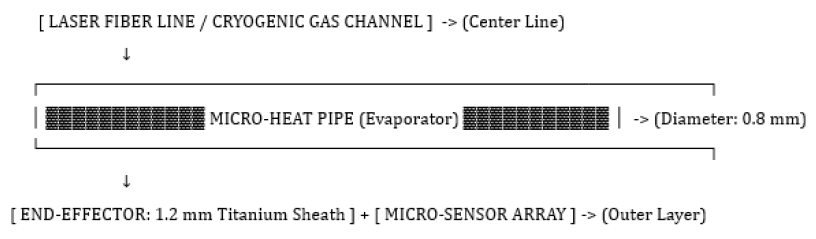
Ultra-Thin Diameter Technology (0.8 - 1.2 mm):
• The outer diameter of the cutting instrument at the tip of the robotic arm is optimized to be at most 1.2 mm.
• The micro-heat pipe inside is a flexible copper-titanium or graphene alloy tube with a thickness of 0.8 mm.
Capillary Structure (Wick Structure) and Nano-Fluid Selection:
• In brain surgeries, the robot arm constantly changes angles. To operate independently of gravity, the inside of the heat pipe is coated with sintered copper powder micro-capillaries.
• Water-graphene nano-fluids, whose heat transfer rate is 40% higher than normal water and provide full compliance with Elmas’s theory, are used as the fluid.
Flexible Joint Integration:
• To enable the robot to move within the curves of the brain, the heat pipes are designed as flexible bellows. Thus, even if the robotic wrist is bent 90 degrees, phase change and heat transfer inside are not interrupted.
Clinical Simulation Stages (5-Step Verification)
The system must pass a rigorous testing process before it can enter the operating room and the AI software can correctly protect the brain.
[ STEP 1 ] ──> [ STEP 2 ] ──> [ STEP 3 ] ──> [ STEP 4 ] ──> [ STEP 5 ]
Computerized Synthetic Gel Ex-Vivo Tissue In-Vivo Animal Pre-Clinical
Thermal Model Laboratory Tests Experiments Human Simulation
Step 1: Computerized Thermal Modeling (Numerical Simulation)
• Process: Dr. Elmas’s thermodynamic equations are transferred to ANSYS Fluent or COMSOL software.
• Purpose: The heat dissipation that the laser will create in the brain tissue and the ice-ball volume of the cryoprobe are simulated in a computer environment. The AI’s “thermal prediction controller” is trained with this digital data.
Step 2: Synthetic Gel Laboratory Tests (Phantom Gel)
• Process: Ballistic agarose gel molds that 100% mimic the thermal and mechanical properties of the human brain are prepared.
• Purpose: The robotic arm enters the gel. The laser is fired and the cryoprobe is operated. The time it takes for the heat pipe to evacuate heat is measured with millisecond precision using fiber optic thermocouples placed inside the gel. The AI’s “live colorful heat map” is calibrated on the interface.
Step 3: Ex-Vivo Tissue Tests (Organic Verification)
• Process: Tests are performed on fresh bovine brain tissues obtained from slaughterhouse animals.
• Purpose: Thermal damage boundaries are determined in real cellular structures. Post-operative tissues are examined under a microscope (histological analysis) to prove whether the heat pipe reduces thermal necrosis (cell death) to zero.
Step 4: In-Vivo Animal Experiments (Live Blood Flow Effect)
• Process: Studies are conducted under anesthesia on ethics- approved live animal models (usually pig or sheep brain structures).
• Purpose: Blood flow (perfusion) in live tissue is like a cooling tower that naturally dissipates heat. The system updates AI algorithms by taking the thermal effects of blood flow into account. The accuracy of haptic safety locks (the robot’s reflex to stop the surgeon) in a live subject is tested.
Step 5: Pre-Clinical Human Simulation (Cadaver & VR)
• Process: A surgeon sits at a real console. The robot is used by wearing virtual reality (VR) glasses or on medical cadavers.
• Purpose: Whether the interface (HUD) tires the surgeon (cognitive load), the clarity of warnings, and the compliance of haptic feedbacks with the surgeon’s hand sensation are tested one last time, making the surgical robot ready for surgical operations. [1-111]

International Association of Landscape Archaeology, Czech Glass Society, Czech Republic

Department of Chemistry, Semenov Institute of Chemical Physics, USSR Academy of Sciences, Moscow, Russia
Associate Professor at Department of Breast and Thyorid Surgey, Chongqing General Hospital, China

Professor of Nuclear Medicine, Faculty of Medicine and Surgery, University of Milan, Milan, Italy

Department of Pharmaceutical Sciences, South University School of Pharmacy, USA





 Abstract
 PDF