[email protected]
+1 (502) 904-2126
One Westbrook Corporate Center, Suite 300, Westchester, IL 60154, USA
Site Map
 ISSN: 2574 -1241
Received: October 05, 2026; Published: October 15, 2026
*Corresponding author: Velimir Jeknic, SOKO Locomotion Consultancy, Abu Dhabi, UAE, Neuro-Biomechanics. Sports Performance & Training Consultancy, Abu Dhabi, UAE
DOI: 10.26717/BJSTR.2026.67.010439
Background: Karate requires rapid expression of force, power, velocity, and acceleration during technically
specific movements. Individual load - performance profiling may provide information that is not captured by
generalized laboratory tests.
Case Presentation: One male competitive karate athlete (31 years; 193 cm; 92 kg; 18 years of competitive experience)
performed gyaku zuki (reverse punch), mae geri (front kick), and change of stance movements against
multiple external resistance loads. Peak and average power, force, speed, and acceleration were recorded using
a cable-based resistance and measurement system.
Observations: During gyaku-zuki, peak power increased from 520 W at 2 kg to 1118 W at 14 kg on the non-dominant
and dominant sides, respectively, while peak speed reached 5.24 m/s and 5.19 m/s at 2 kg. During maegeri,
peak power reached 896 W in the non-dominant leg and 1077 W in the dominant leg at 14 kg, whereas peak
speed at 2 kg was 4.10 and 4.69 m/s, respectively. During change of stance, peak power increased from 177 W at
4.5 kg to 699 W at 22.5 kg, while peak force increased from 88 to 383 N.
Conclusion: This single-athlete case demonstrates distinct load-dependent mechanical profiles across punching,
kicking, and whole-body displacement. Lower loads exposed higher movement velocity, whereas higher
loads produced greater force and power. The findings illustrate the potential usefulness of individualized
sport-specific load–performance profiling, but they cannot be generalized to other karate athletes without further
investigation.
Keywords: Karate; Combat sports; Mechanical performance; Force; Power; Velocity; Acceleration; Load-performance profile; Case study
Karate performance is characterized by the rapid generation and control of mechanical output during short-duration, technically demanding actions [1]. Competitive performance requires athletes to coordinate the upper limbs, lower limbs, trunk, and whole-body movement while producing force within very short time periods [2]. Force, power, velocity, and acceleration are therefore important physical and biomechanical characteristics in karate performance [3-7]. Previous investigations of karate athletes have commonly used standardized assessments such as isokinetic testing, strength and power batteries, jumping and sprint tests, and other field-based measures [8-12]. Tensiomyography has also been used to characterize involuntary muscle contractile properties in karate athletes [13,14]. These approaches provide useful information about general physical or neuromuscular characteristics; however, the mechanical constraints and movement patterns of standardized tests can differ from those of karate techniques. Sport-specific resisted testing provides an opportunity to examine mechanical output during movements that more closely resemble the technical actions performed in karate. Cable- based systems can apply controlled external resistance while continuously recording variables such as force, velocity, acceleration, and power. Previous work has examined the validity or application of such systems in strength and isokinetic tests and exercises [15,16]. The purpose of this case study was not to establish normative values or test statistical differences between athletes. Instead, the purpose was to describe the load-dependent mechanical response of one experienced competitive karate athlete during three sport-specific movements: gyaku zuki, mae geri, and change of stance. The case focuses on how force, power, speed, and acceleration changed as external resistance was progressively altered and on the practical information that may be obtained from an individualized profile.
Case Description
The case involved one male competitive karate athlete aged 31 years, with a body height of 193 cm, body mass of 92 kg, and 18 years of competitive experience. The participant was an active competitive athlete and had no reported health restriction that prevented performance of the selected movements. The participant provided informed consent before testing, and the measurements were reported as being performed in accordance with the ethical standards of the Declaration of Helsinki. Because only one athlete was assessed, no group-level descriptive statistics, inferential statistical testing, classification analysis, or population-level normative interpretation was performed. The individual athlete was treated as the unit of observation.
Experimental Design
The assessment used a cross-sectional single-case design. Three karate-specific movements were examined: gyaku zuki, mae geri, and change of stance. Each movement was performed against predefined external resistance loads using the 1080 Quantum resistance and measurement system (1080 Motion AB, Stockholm, Sweden). The system records cable displacement and tension during movement, allowing mechanical variables to be derived during the execution of the selected action [17,18]. The athlete was instructed to perform each movement with maximal intentional effort while maintaining the prescribed technical execution. Starting position and cable attachment were standardized for each movement. At each load, five repetitions were performed. A 10-second rest interval was provided between individual repetitions (for the non-dominant and subsequently dominant hand, leg, and stance), while a 2-minute recovery interval was allowed between successive loads. For the analysis, the repetition that elicited the highest peak value was selected and saved.
Karate-Specific Movement Tests
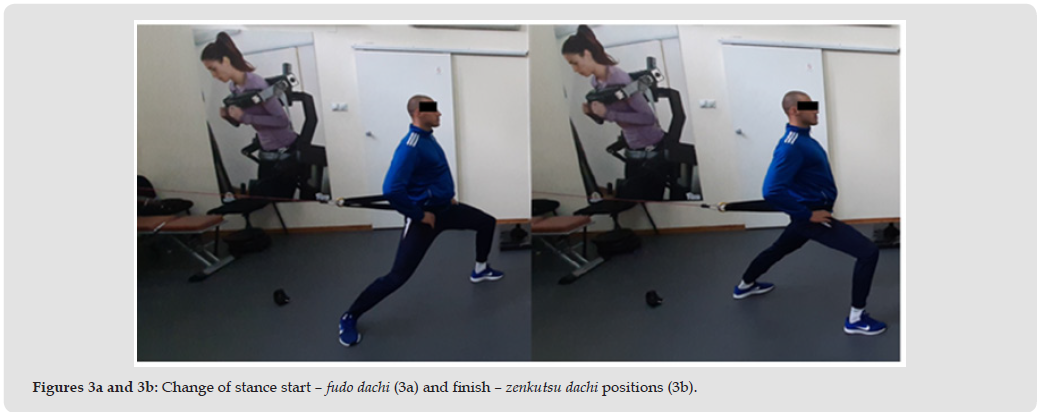
Gyaku zuki. The handle was held in the punching hand, with the hand positioned close to the hip in the preparatory position (Figure 1a). The athlete performed the reverse punch from the hip toward full extension of the striking arm (Figure 1b). Mechanical data were recorded from movement initiation to completion of the strike. Mae geri. The cable was attached to the kicking leg using a strap positioned close to the foot. The kicking leg started behind the body while the supporting leg remained on the ground (Figure 2a). The athlete then performed the front kick toward full extension (Figure 2b), with data recorded throughout the movement. Change of stance. The cable was attached to a belt around the athlete’s waist. Starting from one karate stance (Figure 3a), the athlete rapidly displaced the body forward and changed the position of the legs until the opposite stance was established Figure (3b). This movement was intended to represent rapid whole-body displacement rather than an isolated limb action.
Figure 1
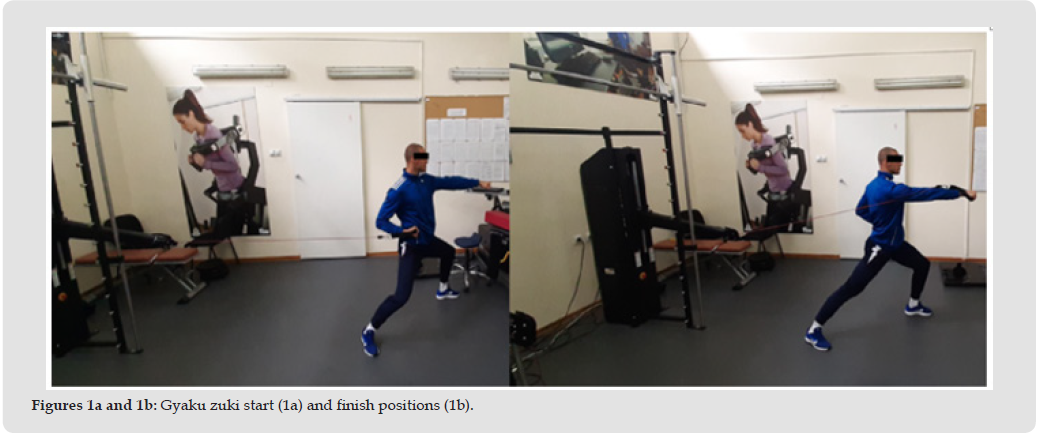
Figure 2
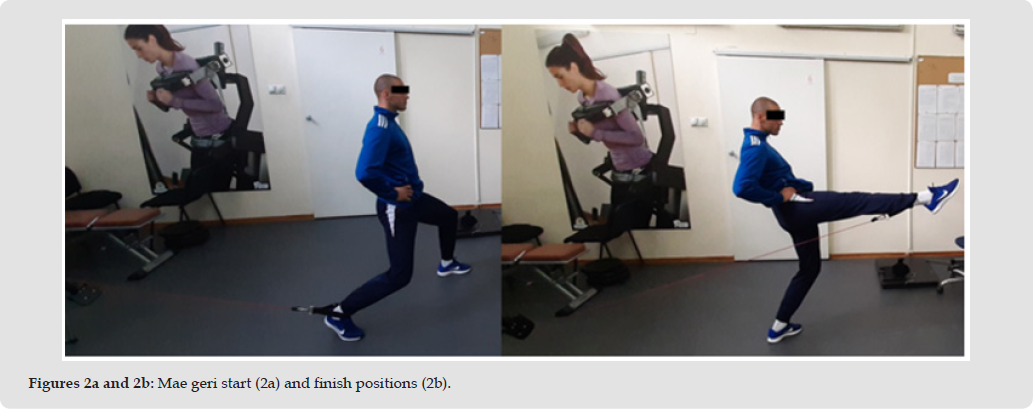
Figure 3
External Loads and Outcome Measures
For gyaku zuki and mae geri, loads of 2, 4, 6, 8, 10, 12, and 14 kg were examined. For change of stance, loads of 4.5, 9, 13.5, 18, and 22.5 kg were examined. Peak and average power, force, speed, and acceleration were extracted for each condition. Peak values represented the highest instantaneous value recorded during the analyzed movement, whereas average values represented the mean value across the measurement interval. Force represented cable tension, speed represented cable displacement velocity, acceleration represented the rate of change in velocity, and power represented the mechanical output associated with force and velocity.
No inferential statistical analysis was undertaken because the dataset represented a single participant. Results were interpreted descriptively by examining the direction and magnitude of changes across loads and, where applicable, differences between dominant and non-dominant limbs.
The individual results are presented in Tables 1–3. The observations describe the athlete’s response across resistance conditions and should not be interpreted as normative values for competitive karate athletes.
Table 1: Individual mechanical responses during gyaku zuki.
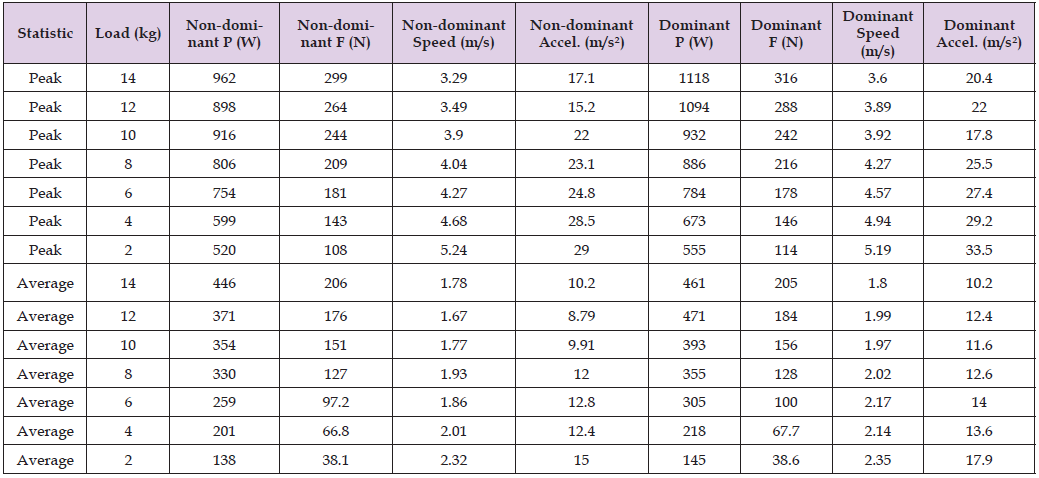
Table 2: Individual mechanical responses during mae geri.
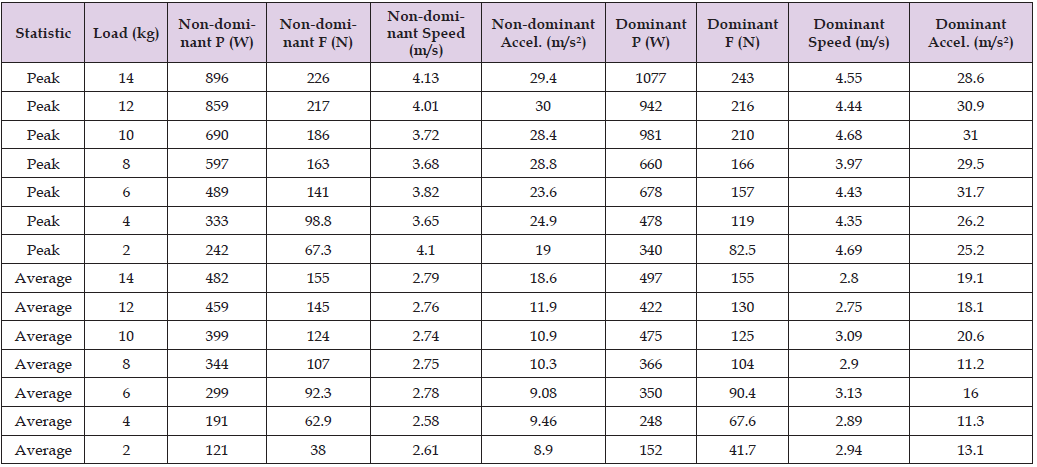
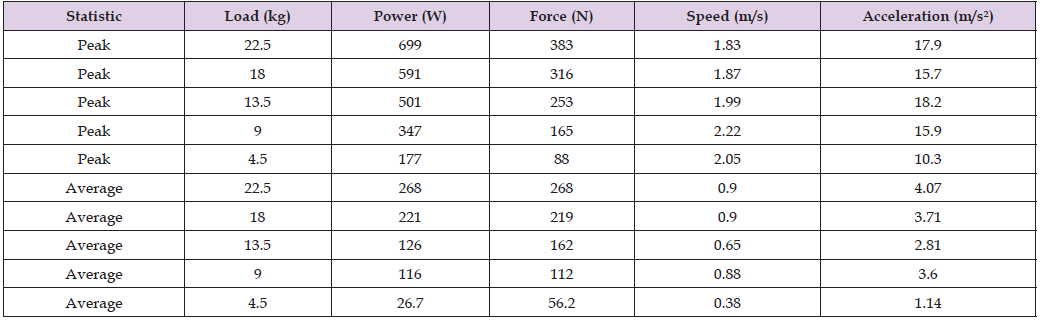
Table 3: Average mechanical responses during change of stance.
Gyaku zuki
The gyaku zuki profile showed a clear load-dependent trade-off between external resistance and movement velocity. On the dominant side, peak power increased from 555 W at 2 kg to 1118 W at 14 kg, while peak force increased from 114 to 316 N. Peak speed moved in the opposite direction, from 5.19 m/s at 2 kg to 3.60 m/s at 14 kg. Peak acceleration ranged from 33.5 m/s² at 2 kg to 20.4 m/s² at 14 kg. The non-dominant side showed a similar pattern. Peak power increased from 520 W at 2 kg to 962 W at 14 kg, and peak force increased from 108 to 299 N. Peak speed decreased from 5.24 to 3.29 m/s as load increased. Thus, in this athlete, lower resistance exposed the highest peak movement velocity, whereas higher resistance produced greater peak force and power.
Dominant-side values were generally higher for peak power, although the pattern was not uniform for every variable and load. For example, peak force at 10 kg was slightly higher on the non-dominant side (244 N) than on the dominant side (242 N). This illustrates why the case should be interpreted as an individual profile rather than as evidence of a generalized dominance effect.
Mae geri
The mae-geri profile also demonstrated substantial changes with resistance. Peak power on the dominant leg ranged from 340 W at 2 kg to 1077 W at 14 kg, while peak force ranged from 82.5 to 243 N. Peak speed was highest at the lowest load, reaching 4.69 m/s at 2 kg, and remained above 4.3 m/s from 4 to 14 kg except at 8 kg.The non-dominant leg reached a peak power of 896 W and peak force of 226 N at 14 kg. Its highest peak speed was 4.13 m/s at 14 kg and 4.10 m/s at 2 kg. The dominant leg generally demonstrated higher peak power and speed, although peak force at 12 kg was slightly greater on the non-dominant side (217 vs. 216 N). Average values were less consistently ordered than peak values, reinforcing the importance of distinguishing instantaneous peak output from the mechanical output sustained across the movement interval.
Change of Stance
The change of stance task produced a different mechanical profile because resistance was applied through the athlete’s waist and the movement involved whole-body displacement. Peak power increased from 177 W at 4.5 kg to 699 W at 22.5 kg, while peak force increased from 88 to 383 N. Peak acceleration increased from 10.3 to 17.9 m/ s². Peak speed varied between 1.83 and 2.05 m/s and did not decline progressively with increasing resistance. Average power and force also increased across the tested range, from 26.7 W and 56.2 N at 4.5 kg to 268 W and 268 N at 22.5 kg. Average speed ranged from 0.38 to 0.90 m/s. In this individual, the change of stance task therefore displayed a strong increase in force and power with resistance while maintaining a relatively narrow range of peak velocity.
The principal observation from this case is that the athlete did not display a single mechanical performance profile that could be represented by one resistance level. Instead, the mechanical response changed according to the movement and the applied load. In the two striking movements, lower resistance was associated with higher peak velocity, whereas higher resistance produced greater peak force and power. The change of stance task showed a different response, with force and power increasing substantially as resistance increased while peak speed remained within a comparatively narrow range.The gyaku zuki findings illustrate the practical value of examining several loads rather than selecting one resistance condition. At 2 kg, the athlete achieved peak speeds of 5.19 m/s on the dominant side and 5.24 m/s on the non-dominant side. At 14 kg, peak speed decreased to 3.60 and 3.29 m/s, respectively, while peak power increased to 1118 and 962 W (Table 1). This reflects the expected mechanical trade-off between the ability to move rapidly against low resistance and the ability to produce high force and power against greater resistance [19, 20]. Force - velocity characteristics have particular relevance in karate, and a recent systematic review of elite WKF karate athletes emphasized the importance of the velocity component in the force - velocity profile of successful karatekas [21]. The mae geri profile provided a similar example. The dominant leg reached 1077 W at 14 kg, whereas its highest speed of 4.69 m/s occurred at 2 kg. The non-dominant leg showed lower peak power at the highest load (896 W) and a peak speed of 4.10 m/s at 2 kg (Table 2). These observations suggest that different loads may expose different components of an athlete’s mechanical capacity. High-load conditions may be useful when the practitioner is interested in force and power expression, whereas lower-load conditions may be more informative when the objective is to examine rapid movement.The dominant / non-dominant comparisons should be interpreted cautiously. The dominant side generally showed greater peak power in both striking movements, but the differences were not uniform across all variables and loads (Table 2). Such variability may reflect the technical organization of the individual athlete, habitual use of one side, movement strategy, or task-specific coordination. Previous work has reported effects of hand dominance on force and speed in martial arts strikes [22], but a single case cannot establish whether the pattern observed here is typical of karate athletes. The change of stance results are particularly interesting because the cable was connected to the waist rather than directly to a striking limb (Figures 3a, 3b). Consequently, the measured mechanical output represents the athlete’s interaction with external resistance during whole-body displacement.
Peak force increased more than fourfold between the lowest and highest loads, from 88 to 383 N, and peak power increased from 177 to 699 W. In contrast, peak speed remained between 1.83 and 2.22 m/s (Table 3). This may indicate that the athlete maintained a relatively stable displacement velocity while producing progressively greater mechanical output against increasing resistance [23]. From a sport science perspective, the principal value of the present case is methodological and practical rather than normative. A load–performance profile obtained during a movement that resembles a karate technique can provide an individualized description of how an athlete expresses force, power, speed, and acceleration. This may complement standardized strength, jump, sprint, isokinetic, and other laboratory assessments, which remain useful but do not reproduce every feature of karate-specific movement.The present case also supports the use of both peak and average measures. Peak values describe the athlete’s maximal instantaneous response and are particularly informative for rapid striking actions. Average values describe mechanical output over the analyzed movement interval and may provide complementary information about the overall expression of mechanical output. The two measures did not always change in parallel, indicating that reporting only one type of value could overlook relevant features of the individual movement profile.
For practitioners, the case illustrates a simple principle: resistance selection should be linked to the physical quality being monitored or trained. In this athlete, low-load conditions revealed high movement velocity and acceleration during gyaku zuki and mae geri, whereas high-load conditions elicited greater force and power. For change of stance, higher resistance produced marked increases in force and power without a proportional loss of peak speed. Repeated testing of the same athlete under the same standardized conditions may therefore be useful for monitoring changes over time. For example, an athlete could be reassessed periodically to determine whether peak velocity at a low load, peak power at a higher load, or the shape of the individual load–performance profile changes following a training intervention. Such longitudinal use would be more appropriate than interpreting a single measurement as a normative benchmark.
The principal limitation is that this study describes one athlete only. Consequently, the observations cannot be generalized to other karate athletes, weight categories, sexes, competitive levels, or technical styles. No inferential statistical analysis was appropriate for the single-case dataset, and no normative threshold or population reference value can be established from these measurements. The assessment was also cross-sectional and therefore cannot determine training effects or causal relationships. In addition, the measured cable variables should be interpreted as mechanical outputs generated within the specific testing configuration rather than as direct measures of the force or power produced at the anatomical joint or by a particular muscle group. Future work should examine larger samples of karate athletes and incorporate repeated testing to determine within-athlete reliability and longitudinal sensitivity. Studies comparing athletes across competitive levels, sex, weight categories, and dominant side characteristics may further clarify the usefulness of individualized load - performance profiling.
This case study demonstrates that sport-specific resisted testing can provide a detailed individual profile of mechanical performance during karate movements. In the examined athlete, lower loads during gyaku zuki and mae geri were associated with greater peak movement velocity, whereas higher loads produced greater peak force and power. The change of stance movement showed a distinct whole-body profile characterized by increasing force and power with resistance and comparatively stable peak speed. These observations support the potential use of individualized load - performance profiling as a complementary tool for sport-specific assessment and monitoring. They should be regarded as exploratory observations from a single athlete and not as normative findings.

International Association of Landscape Archaeology, Czech Glass Society, Czech Republic

Department of Chemistry, Semenov Institute of Chemical Physics, USSR Academy of Sciences, Moscow, Russia

Associate Professor at Department of Breast and Thyorid Surgey, Chongqing General Hospital, China

Professor of Nuclear Medicine, Faculty of Medicine and Surgery, University of Milan, Milan, Italy

Department of Pharmaceutical Sciences, South University School of Pharmacy, USA





 Abstract
 PDF