[email protected]
+1 (502) 904-2126
One Westbrook Corporate Center, Suite 300, Westchester, IL 60154, USA
Site Map
 ISSN: 2574 -1241
Received: September 17, 2026; Published: October 13, 2026
*Corresponding author: Loso Judijanto, IPOSS Jakarta, Indonesia.
DOI: 10.26717/BJSTR.2026.67.010435
Squalene is a strategically important pharmaceutical lipid used in established oil-in-water vaccine adjuvants and increasingly investigated in nanomedicine. Conventional pharmaceutical supply has historically relied substantially on shark-liver-derived squalene, creating concerns regarding biodiversity, supply security, and sustainability. Palm fatty acid distillate (PFAD), a high-volume side-stream of palm-oil physical refining, contains squalene within its unsaponifiable fraction and has recently become a technically credible alternative feedstock. A 2025 pilot-scale study demonstrated approximately 90.95% squalene recovery, nearly 60-fold enrichment, and maximum purity of 98% from a PFAD-processing residue. This review critically evaluates whether such progress can support eventual pharmaceutical-grade and vaccine-adjuvant applications. The evidence indicates that high chemical purity represents only an intermediate milestone. PFAD-derived squalene must additionally demonstrate comprehensive impurity characterization, oxidative stability, analytical traceability, pharmacopeial compliance, formulation performance, sterile-manufacturing compatibility, toxicological acceptability, and immunological equivalence to established pharmaceutical squalene. Renewable microbial and semisynthetic technologies provide particularly important benchmarks because kilo-scale GMP production and functional equivalence in vaccine emulsions have already been demonstrated. A source-to-function equivalence framework and staged PFAD-to-pharmaceutical validation pathway are proposed. PFAD-derived squalene is therefore best regarded as a promising candidate pharmaceutical feedstock whose ultimate value will depend on demonstrating reproducible quality, functional equivalence, GMP scalability, and genuine environmental and supply-chain advantages.
Keywords: Palm Fatty Acid Distillate; Squalene; Vaccine Adjuvant; Pharmaceutical-Grade Squalene; MF59; Oil- In-Water Emulsion; Nanomedicine; GMP Manufacturing; Sustainable Pharmaceutical Supply; Circular Bioeconomy
Squalene is a naturally occurring linear triterpene, chemically represented as C₃₀H₅₀, that occupies an important biosynthetic position upstream of sterols in animals, plants, fungi, and many microorganisms. Its highly lipophilic character, six carbon–carbon double bonds, biocompatibility, and distinctive interfacial properties have made it relevant not only to food and cosmetic applications but also to pharmaceutical technologies. In contemporary biomedicine, one of its most consequential roles is as the oil phase of established oilin- water vaccine-adjuvant systems. Squalene-containing emulsions such as MF59 and AS03 have accumulated substantial human-use experience and have demonstrated the capacity to enhance antibody responses, broaden immune recognition, facilitate antigen dose sparing, and support pandemic vaccine strategies [1-5]. The pharmaceutical importance of squalene therefore extends beyond the value of the molecule as a generic natural product. Vaccine-grade squalene is a functional raw material whose chemical quality, oxidation state, impurity pattern, reproducibility, and compatibility with tightly controlled emulsion-manufacturing processes may influence the performance of a finished pharmaceutical formulation. The practical significance of this requirement became particularly apparent during recent pandemic-preparedness efforts, when adjuvant scalability and antigen dose sparing became important considerations for maximizing vaccine availability. Manufacturing studies have demonstrated that stable squalene emulsions can be scaled from relatively small production volumes to multi-million-dose batches, illustrating that raw-material availability and quality can become strategically relevant during global demand surges [2,6,7].
Historically, pharmaceutical squalene has been strongly associated with shark liver oil. This sourcing pathway is increasingly difficult to defend as the only long-term option because biodiversity pressures on sharks have become scientifically well documented. Pacoureau, et al. [8] estimated a 71% decline in global oceanic shark and ray abundance since 1970 among the assessed populations, with overfishing identified as the dominant driver. Although the pharmaceutical industry is not the only or necessarily the principal cause of shark exploitation, dependence on shark-derived material creates an avoidable linkage between biomedical supply and vulnerable marine resources. Consequently, interest has accelerated in plant-derived, microbial, and semisynthetic sources capable of producing pharmaceutical- quality squalene at industrial scale [1,8-10]. Recent developments demonstrate that sustainable replacement is technologically feasible rather than merely aspirational. Fisher, et al. [11] synthesized a family of fermentation-derived terpenoid analogues and demonstrated that selected molecules could reproduce or even exceed some adjuvant properties of shark-squalene emulsions in experimental models. More importantly for direct substitution, Fisher, et al. [12] reported kilo-scale good manufacturing practice (GMP) synthesis of renewable semisynthetic squalene derived from fermentation-based β-farnesene. The resulting material met relevant pharmacopeial requirements, exceeded 99% purity expectations, exhibited physical stability in an oil-in-water adjuvant emulsion, and showed biological performance comparable with shark-derived squalene in a preclinical influenza model. These studies establish a demanding contemporary benchmark for any new source proposed for vaccine manufacture [11,12].
Against this background, palm fatty acid distillate (PFAD) represents an unconventional but strategically interesting source. PFAD is generated during the physical refining of palm oil, particularly during high-temperature deodorization and free-fatty-acid removal. Although dominated by free fatty acids and other bulk lipid components, PFAD contains an unsaponifiable fraction incorporating valuable minor constituents such as tocopherols, tocotrienols, phytosterols, and squalene. Earlier research focused primarily on separation chemistry and the recovery of individual phytonutrients, demonstrating that saponification, solvent extraction, crystallization, supercritical- fluid extraction, and related approaches could concentrate valuable unsaponifiable compounds from PFAD [13-16]. The scientific status of PFAD-derived squalene changed substantially with a 2025 pilot-scale study by Jalani et al. The investigators used a sequential process incorporating molecular distillation, adsorption chromatography, and activated-carbon polishing to recover squalene from a liquid PFAD-processing residue remaining after vitamin E extraction. The starting material contained approximately 20,000 ppm squalene; the process achieved 90.95% recovery, approximately 60-fold overall enrichment, and a maximum reported purity of 98%. FTIR and NMR analyses supported molecular identity. This study is particularly important because it shifts PFAD-derived squalene from laboratory- scale possibility to credible process-scale candidate material [17].
Nevertheless, 98% squalene is not automatically pharmaceutical- grade squalene, and pharmaceutical-grade squalene is not automatically vaccine-adjuvant-grade material. A chromatographic purity percentage does not by itself reveal the identity, toxicological significance, or batch consistency of the remaining approximately 2%. Nor does it establish whether oxidative degradation products are controlled, residual solvents fall within pharmaceutical limits, or the material meets applicable pharmacopeial and manufacturing requirements. Most importantly, chemical identity alone does not prove that an oil-in-water emulsion manufactured using PFAD-derived squalene will reproduce the droplet characteristics, storage stability, innate immune activation, adaptive responses, reactogenicity, and toxicological performance of an established reference squalene. The distinction between molecular identity and functional equivalence is especially important for vaccine adjuvants. Mechanistic evidence shows that squalene-based emulsions influence immune-cell recruitment, antigen- presenting-cell activation, cell-death pathways, germinal-center responses, B-cell maturation, antibody breadth, and T-cell responses. Different emulsion compositions that contain squalene can nevertheless generate distinct immunological signatures, demonstrating that the biological product cannot be understood solely from the chemical formula of its oil phase [3,5,18,19].
The question is therefore no longer merely whether PFAD contains squalene or whether it can be isolated at high purity. The more consequential question is whether a palm-refinery side-stream can be transformed through validated purification, analytical control, pharmaceutical formulation, functional testing, and GMP scale-up into a material equivalent to incumbent pharmaceutical squalene. Answering that question connects palm-oil refining with vaccinology, pharmaceutical quality systems, nanotechnology, industrial biotechnology, biodiversity conservation, and global biomedical supply security. This qualitative literature review critically evaluates that translational possibility. It synthesizes recent evidence on PFAD-derived squalene recovery, alternative squalene production technologies, squalene chemistry and oxidation, pharmaceutical analytical requirements, vaccine-emulsion formulation, immunological mechanisms, nanomedicine applications, manufacturing scale-up, and sustainability. The review explicitly distinguishes evidence demonstrating that PFAD is a candidate source from evidence that would be required to claim pharmaceutical-grade, vaccine-adjuvant-grade, or clinically equivalent status.
Squalene Chemistry and Pharmaceutical Relevance
Squalene is an acyclic triterpene consisting of six isoprene-derived units and six non-conjugated carbon–carbon double bonds. Its structure produces extreme hydrophobicity and a flexible hydrocarbon chain that permits incorporation into lipid phases and biological membranes. In endogenous metabolism, squalene represents a central intermediate between farnesyl pyrophosphate and downstream sterols, including cholesterol in animals and ergosterol in fungi. Recent reviews have emphasized that this biochemical position coexists with important technological properties relevant to foods, cosmetics, pharmaceuticals, and drug delivery [20-22]. The same molecular architecture that makes squalene functionally interesting also creates a major stability challenge. Six double bonds make the molecule susceptible to oxidation by reactive oxygen species, light, heat, ozone, and metal-catalyzed processes. Coffaro & Weisel [23] demonstrated the chemical diversity of products arising from squalene oxidation, while Yao & Li [24] investigated singlet-oxygen quenching and thermal degradation behavior. These observations are particularly important for pharmaceutical manufacture because oxidation is not simply a question of declining assay concentration; it may generate new molecular species with different physicochemical or biological properties [23,24].
Analytical metrology is consequently important. Chen, et al. [25] developed a certified squalene reference material using mass-balance and quantitative NMR approaches, with a certified purity of 99.4% and explicit assessment of homogeneity, stability, and uncertainty. Such work illustrates the level of analytical rigor expected when squalene moves from a natural extract to a regulated high-purity raw material. Pharmaceutical qualification therefore requires traceable identity, assay, related-substance characterization, and stability evidence rather than reliance on a single GC or HPLC area percentage [25].
Competing Sources of Squalene
Shark liver oil is historically important because certain deep-sea species contain large amounts of squalene, making purification relatively efficient. Its disadvantages include ecological concerns, dependence on fisheries, variability in biological raw material, and negative public perceptions related to shark exploitation. These concerns have increased interest in non-animal alternatives, particularly because global shark and ray populations face substantial fishing pressure and conservation challenges [1,8].
Vegetable sources include olive oil and olive-processing residues, amaranth, rice bran, and other lipid materials. Their advantages include plant origin and compatibility with existing agricultural systems, whereas disadvantages include relatively low squalene concentration, competition with other uses, seasonal variability, and potentially extensive purification requirements. Studies of olive by-products demonstrate that agricultural residues can become useful secondary squalene sources, supporting the broader concept of waste-stream valorization that also underlies PFAD development [26,27]. Microbial production represents a rapidly developing alternative. Metabolic engineering of Saccharomyces cerevisiae and Yarrowia lipolytica has increased squalene titers through manipulation of the mevalonate pathway, acetyl-CoA supply, NADPH availability, subcellular compartmentalization, lipid droplets, and downstream sterol conversion. Xia, et al. [28] reported improved production in S. cerevisiae, whereas Liu, et al. [29] & Ning, et al. [30] demonstrated substantial improvements in Y. lipolytica. Ning, et al. reported 51.2 g/L in a 5-L bioreactor using cytoplasmic-peroxisomal engineering, and Tang, et al. [31] subsequently reported 55.8 g/L in engineered S. cerevisiae. Recent reviews indicate that yeast engineering has become a credible industrial pathway rather than a laboratory curiosity [9,10,32,33].
Circular microbial routes are also emerging. Wang, et al. [34] used waste cooking oil as the substrate for engineered Y. lipolytica, demonstrating that biotechnology can combine squalene production with waste valorization. Microalgae represent another renewable platform, although productivity, cultivation costs, downstream recovery, and application-specific purification remain constraints [34,35]. The most relevant competitive benchmark for vaccine applications is renewable semi synthesis. Fisher, et al. [12] used fermentation-derived trans-β-farnesene as feedstock for GMP synthesis of vaccine-grade squalene. Crucially, the study did not stop after achieving high chemical purity. The material was formulated into a vaccine-adjuvant emulsion, compared with shark-derived squalene for physicochemical stability, and assessed for biological activity. This establishes an appropriate development standard for PFAD-derived material: the source is acceptable only when the final pharmaceutical function is demonstrated.
PFAD as a Source of Squalene
PFAD is produced during palm-oil physical refining when volatile free fatty acids and other components are removed under high-temperature vacuum conditions. Its exact composition is process dependent. Beyond free fatty acids, PFAD contains acylglycerols and valuable minor components, including vitamin E homologues, phytosterols, and squalene. These minor constituents have encouraged research into fractionation as a means of converting a relatively low-value side-stream into higher-value products [13,14]. Recent PFAD research demonstrates that different processing sequences can selectively enrich different unsaponifiable components. Jalani, et al. [13] developed multistage extraction of phytosterols from a PFAD-derived process stream, while Gore & Bhagwat [14] demonstrated recovery and fractionation of tocols and phytosterols. Othman, et al. [15] investigated supercritical-carbon-dioxide extraction of tocotrienols from hydrolyzed PFAD. Although these studies did not primarily target pharmaceutical squalene, they are relevant because they demonstrate how saponification, crystallization, pressure, temperature, and solvent selection reshape the impurity environment surrounding squalene. Widiputri, et al. [16] specifically investigated enhanced pretreatment for squalene extraction from PFAD, identifying residual free fatty acids as important impurities that complicated downstream enrichment. That problem is highly relevant to pharmaceutical development because a raw squalene concentrate can retain a chemically complex mixture of fatty acids, glycerides, sterols, tocotrienols, and oxidation products. Purification must therefore be designed around a defined final specification rather than around maximizing squalene concentration alone. The strongest contemporary evidence is provided by Jalani, et al. [17]. Their pilot-scale process used molecular distillation, followed by silica-based adsorption chromatography and activated-carbon polishing. Distillation at approximately 120-140°C yielded a squalene-rich fraction; selective desorption using n-hexane produced material with up to 98% squalene purity, while total recovery reached 90.95% and overall enrichment approached 60-fold. This is a major technological advance, but its correct interpretation is that PFAD can yield a high-purity squalene candidate at pilot scale, not that vaccine-grade status has already been reached. Ahmadi, et al. [36] provide complementary evidence by demonstrating that PFAD-derived unsaponifiable fractions containing squalene, tocopherols/ tocotrienols, and phytosterols can be formulated into self-nanoemulsifying systems. Their study is not evidence of purified PFAD squalene suitability for vaccines, but it confirms that PFAD minor components can enter sophisticated lipid formulation research and underscores the importance of understanding the physicochemical behavior of palm-derived lipids.
What “Pharmaceutical-Grade” Must Mean
A major conceptual problem in natural product research is the casual use of terms such as “high-purity,” “pharmaceutical-grade,” and “vaccine-grade” as though they were interchangeable. They are not. High purity typically refers to an assay result. Pharmaceutical grade requires compliance with an applicable quality standard, validated manufacturing controls, defined impurity specifications, stability, traceability, and reproducibility. Vaccine-grade use adds additional considerations because the material enters a parenteral formulation whose performance and safety are tightly controlled [7,12]. For PFAD-derived squalene, a future specification would need to consider at least identity, assay, known related substances, unknown impurities, residual free fatty acids, residual sterols and tocotrienols, residual solvents, oxidation products, trace metals, and process-related contaminants. The material would also require validated analytical methods capable of detecting meaningful degradation during storage. The pharmaceutical value of [25] certified reference material is therefore directly relevant: a reference standard provides a metrological anchor for assay and method validation. Palm-oil specific contaminants also deserve evaluation. Refining conditions can influence concentrations of 3-monochloropropane-1,2-diol esters and glycidyl esters, as demonstrated by Hew, et al. [37]. Whether such contaminants partition into a purified PFAD squalene fraction cannot be assumed from their concentration in bulk palm oil; it must be measured directly in the final candidate material.
Squalene-Based Vaccine Emulsions as Functional Pharmaceutical Systems
Squalene-based oil-in-water emulsions are not passive reservoirs. Reviews of MF59, AS03, and related systems indicate that their biological activity emerges from the interaction among oil droplets, surfactants or other excipients, the injection-site environment, innate immune cells, and adaptive immune pathways [2,38-40]. Mechanistic evidence increasingly challenges the older idea that emulsion adjuvants function principally by maintaining an antigen “depot.” Kim, et al. [18] demonstrated RIPK3-dependent pathways relevant to CD8 T-cell responses after immunization with MF59-like squalene emulsions. Nguyen-Contant, et al. [3] described effects on B-cell responses, antibody affinity, and breadth. More recent work has demonstrated that superficially similar squalene-based emulsions can differ in dendritic- cell regulation and pathway dependency, reinforcing the point that composition and formulation matter [41]. α-Tocopherol provides an instructive example. AS03 and certain newer emulsions incorporate α-tocopherol alongside squalene, and Yoshioka, et al. [19] found that the α-tocopherol component of A-910823 contributed to T-follicular- helper-cell and humoral immune responses. Short, et al. [42] likewise demonstrated that additional immune agonists can alter the immune profile of a squalene/α-tocopherol emulsion. Consequently, trace PFAD-derived tocopherols cannot automatically be assumed beneficial merely because α-tocopherol is intentionally included in some licensed or investigational adjuvants. Deliberate formulation and uncontrolled impurity are fundamentally different pharmaceutical circumstances [19,42].
Nanomedicine beyond Vaccine Adjuvants
Squalene is also relevant to nanomedicine through nanoemulsions and the concept of “squalenoylation,” in which a drug is chemically conjugated to squalene to create amphiphilic molecules capable of self-assembly. Brusini, et al. [43] demonstrated squalene-based nanoparticle strategies directed toward atherosclerotic lesions, while Vágvölgyi, et al. [44] investigated squalenoylated nanoparticle prodrugs in oncology-related contexts. These studies show that pharmaceutical demand for squalene need not be limited to vaccine adjuvants [43,44].
The purity requirements for nanomedicine may nevertheless differ from vaccine-adjuvant requirements. A squalene molecule used as the oil phase in a sterile vaccine emulsion must exhibit formulation- compatible purity and stability, whereas squalenoylation chemistry may additionally require highly controlled reactivity and the absence of impurities capable of interfering with derivatization. Thus, “pharmaceutical-grade squalene” should be considered an application- dependent concept supported by a common core specification and additional use-specific quality attributes.
This study used a qualitative literature review design with critical and translational orientation. It was not designed as a systematic literature review or meta-analysis. The qualitative approach was selected because the central research question spans several scientific domains whose study designs and evidentiary standards differ substantially, including palm-oil refining, separation science, analytical chemistry, pharmaceutical quality assurance, vaccine formulation, immunology, metabolic engineering, nanomedicine, sustainability, and manufacturing science. Literature identification focused mainly on peer-reviewed journal literature published from 2020 through 2026. Relevant publications were located through Scopus, Web of Science, PubMed/MEDLINE, and major publisher platforms, using combinations of “squalene,” “vaccine adjuvant,” “MF59,” “AS03,” “oil-in-water emulsion,” “palm fatty acid distillate,” “PFAD,” “squalene extraction,” “pharmaceutical grade,” “GMP,” “semisynthetic squalene,” “microbial squalene,” “oxidation,” “nanomedicine,” “squalenoylation,” “pharmaceutical quality,” “circular economy,” and “sustainable supply.” The search process was intentionally iterative and concept-led rather than exhaustive, because the objective was to integrate contemporary translational evidence across heterogeneous disciplines rather than to conduct a systematic review. The evidence was categorized into six groups. The first comprised direct studies of squalene recovery from PFAD, and the second comprised PFAD fractionation studies relevant to the impurity environment surrounding squalene. The third group covered squalene-based vaccine emulsions and immune mechanisms; the fourth addressed pharmaceutical quality, analytical metrology, and manufacturing control; the fifth examined competing microbial and semisynthetic production technologies; and the sixth covered nanomedicine, environmental performance, and supply-chain resilience. Publications were retained on the basis of their relevance to one or more translational themes and their ability to inform comparisons between demonstrated evidence and unresolved development requirements. Interpretation followed a source-to-function framework. Evidence showing that squalene occurs in PFAD was treated as source evidence. Studies demonstrating recovery or high purity were categorized as process evidence. Pharmaceutical specifications and analytical characterization constituted quality evidence. Emulsion studies represented formulation evidence, whereas immunogenicity and toxicology represented functional evidence. GMP scale-up and clinical comparability were treated as the highest translational levels. This hierarchy was deliberately applied to prevent extraction success from being interpreted as proof of pharmaceutical suitability.
Theme I: PFAD Has Become a Technically Credible Squalene Feedstock
The first major finding is that the scientific question has moved beyond the mere presence of squalene in PFAD. Earlier PFAD research established that squalene resides alongside high concentrations of free fatty acids and smaller amounts of tocotrienols, tocopherols, sterols, and glycerides. Pretreatment and fractionation studies demonstrated that reducing the dominant fatty-acid fraction is essential for meaningful enrichment [14,16]. The 2025 pilot-scale process is the strongest evidence of technical feasibility. Jalani, et al. [17] reported a liquid residue after vitamin E recovery containing approximately 20,000 ppm squalene. Multistage processing produced squalene at a maximum reported purity of 98%, with 90.95% recovery. The study therefore addresses two historically important barriers simultaneously: concentration and scale. It demonstrates that high-purity recovery is possible without starting from a dedicated squalene crop or animal tissue. The distinction between PFAD itself and a PFAD-processing residue is important. The 2025 study effectively uses a secondary side-stream derived from an already valorized primary sidestream. In circular-economy terms, this can be particularly attractive because vitamin E and potentially other high-value fractions may be recovered before squalene purification. However, this sequential processing also means that the history of the material becomes important: previous solvents, temperatures, adsorbents, and storage conditions may influence the downstream impurity and oxidation profile.
Theme II: 98% Purity Marks the Beginning of Pharmaceutical Qualification, Not Its Completion
A reported 98% assay is highly encouraging from a process-development perspective, but pharmaceutical interpretation requires identification of the remaining fraction. If the residual 2% consisted of relatively benign saturated lipids, the risk profile could differ substantially from a fraction containing reactive oxidation products, unknown unsaponifiables, residual solvents, process contaminants, or chemically related terpenes. This issue is illustrated by the semisynthetic benchmark. Fisher, et al. [12] did not define vaccine grade solely by GC purity. Their renewable semisynthetic material was developed against pharmacopeial specifications, subjected to GMP synthesis, formulated into an emulsion, and tested for stability and biological activity. Moreover, the European Pharmacopoeia reference material cited in that work had an assay near 99.8%, while customer expectations were above 99%. PFAD-derived material may therefore require additional purification beyond the current 98% maximum, depending on final related-substance specifications.
A useful future analytical program would combine GC-FID or GCMS for volatile and semivolatile impurities, HPLC for nonvolatile minor components, qNMR for orthogonal purity assessment, FTIR and NMR for identity, peroxide and secondary oxidation measurements, and targeted assays for palm-refining-related contaminants. Certified reference materials such as that developed by Chen, et al. [25] could strengthen traceability.
Theme III: Oxidation May Be the Most Underestimated PFAD-to-Pharmaceutical Barrier
Squalene is particularly vulnerable to oxidation because of its six double bonds. The PFAD pathway subjects the source material to heat during physical refining and may subsequently expose it to additional thermal and solvent processes during fractionation. Although vacuum and controlled processing can limit oxidation, the cumulative oxidative history of the product deserves specific study. Coffaro & Weisel [23] showed that squalene oxidation can generate numerous molecular products, while Yao & Li [24] demonstrated important relationships among squalene, singlet oxygen, and thermal degradation. Möller, et al. [45] further illustrated the relationship between molecular structure and oxidative resilience. These studies collectively support the view that a pharmaceutical PFAD program should quantify not only how much squalene remains but also what oxidation products are generated during recovery and storage. This creates a practical quality-development requirement. Pilot-scale optimization should not select conditions only for maximum recovery or purity. It should use a multi-objective function incorporating squalene yield, chemical purity, oxidation burden, solvent consumption, energy demand, and downstream formulation performance.
Theme IV: Vaccine Squalene Must Be Evaluated as Part of an Emulsion
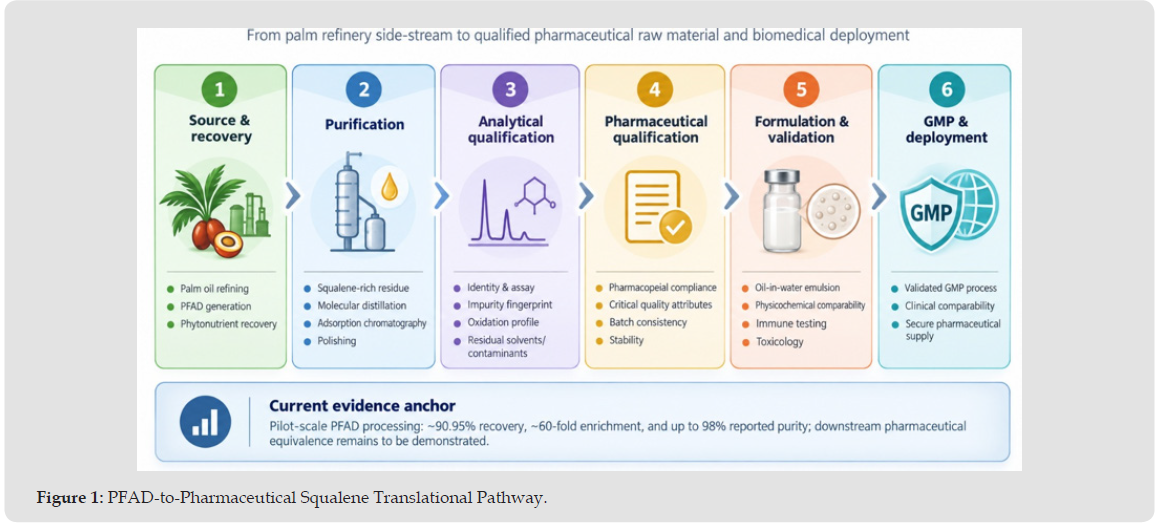
The squalene molecule becomes pharmacologically relevant as a vaccine adjuvant only after formulation. Squalene-based emulsions operate within narrowly defined physicochemical ranges. Droplet diameter, polydispersity, surfactant composition, viscosity, pH, osmolality, chemical integrity, and long-term physical stability can all influence manufacturability and potentially biological performance [2,6,39]. Manufacturing evidence demonstrates that squalene emulsions are scalable when process parameters are carefully controlled. Phan, et al. [6] reported process innovations enabling scale-up from approximately 3,000-dose manufacturing to batches on the order of five million doses. These findings imply that any PFAD-derived substitute must not merely “form an emulsion”; it must behave consistently under high-pressure homogenization or another validated industrial process and remain within predefined critical quality attributes. More recent microfluidic-chip formulation work has shown that squalene emulsion manufacturing can also be redesigned around a simpler platform while retaining non-inferior in vivo adjuvant performance, underscoring the importance of scalability, deployment flexibility, and cost alongside conventional quality attributes [46]. Chae, et al. [47] showed that alternative squalene emulsion approaches using a self-emulsifying system can produce stable formulations with measurable immune activity, while Ho, et al. [48] demonstrated that squalene nanoemulsion can induce mucosal and systemic immune responses in a preclinical model. These studies illustrate the broad formulation flexibility of squalene but also reinforce the need to characterize each formulation independently [47,48]. Figure 1 summarizes the proposed PFAD-to-vaccine-grade pathway and emphasizes that the recovery of a high-purity oil represents only one intermediate step in a much longer translational sequence. It also separates evidence already demonstrated at the recovery stage from the pharmaceutical and clinical evidence that remains outstanding. Figure 1 highlights why the central bottleneck is progressively shifting downstream. Extraction technology has become sufficiently advanced to justify pharmaceutical investigation, but formulation, functional equivalence, GMP reproducibility, and clinical translation remain largely untested for PFAD-derived squalene.
Figure 1
Theme V: Functional Equivalence Cannot Be Assumed from Molecular Equivalence
If two preparations contain chemically identical and equally pure squalene, it is reasonable to hypothesize that they should behave similarly. However, pharmaceutical science requires demonstrating rather than assuming that proposition. Small amounts of impurities can influence interfacial properties, oxidative stability, surfactant interactions, and immune activation. Moreover, different adjuvant emulsions containing the same core oil may produce different immunological responses because of the broader formulation context. Kim, et al. [18] demonstrated that MF59-like emulsions can stimulate CD8 T-cell responses through pathways involving RIPK3, while antibody responses involve distinct mechanisms. Nguyen-Contant, et al. [3] emphasized B-cell and antibody-quality effects, including breadth and affinity. Nakkala, et al. [41] showed differential dendritic-cell regulation and MyD88 dependence between two squalene emulsions. These findings demonstrate that “squalene adjuvant activity” is not one mechanistically uniform phenomenon [3,18,41]. The renewable semisynthetic work again provides a useful model. Fisher, et al. [12] prepared equivalent emulsions containing shark-derived and semisynthetic squalene and followed their physical stability over 12 months, then evaluated biological performance in a mouse influenza model. A similar head-to-head approach would be appropriate for PFAD-derived squalene.
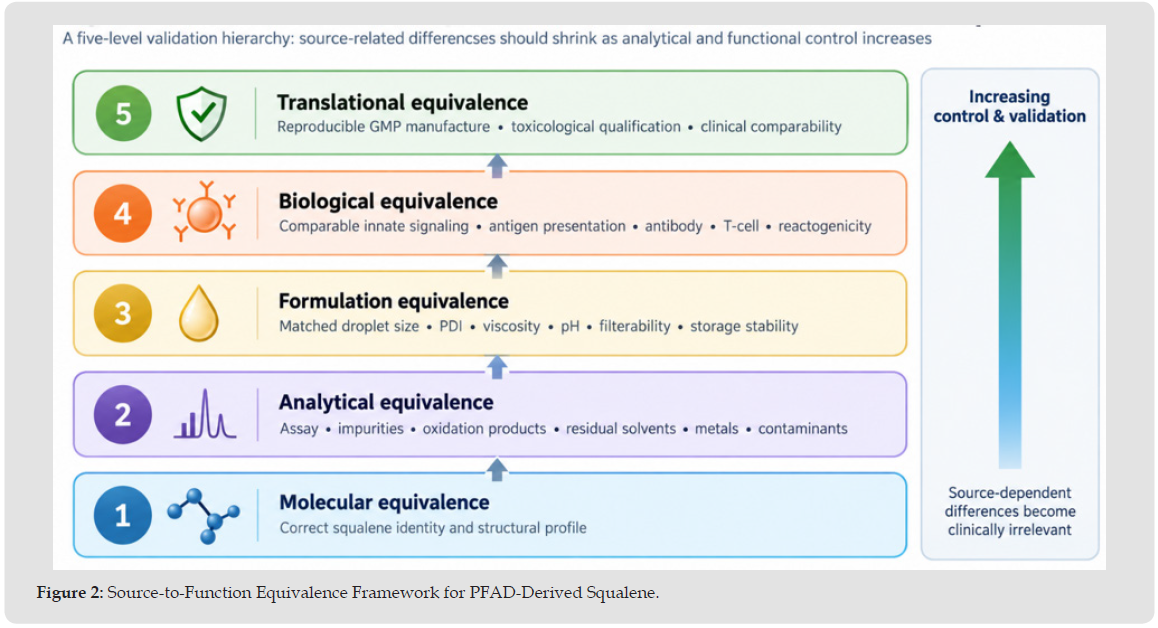
Figure 2 distinguishes five levels of equivalence that should be demonstrated sequentially rather than treating molecular identity as sufficient. The hierarchy therefore treats analytical sameness as a prerequisite rather than a substitute for formulation, biological, and translational comparability. The framework provides a more rigorous answer to the frequently posed question of whether the “source” of squalene matters. At the molecular level, a correctly purified squalene molecule should be source independent. At the product level, however, the source can influence impurity profiles, oxidation, and process variability. The practical goal is therefore to purify and control the material sufficiently that source-dependent differences become clinically irrelevant.
Figure 2
Theme VI: The Immunological Benchmark Is Increasingly Sophisticated
Contemporary vaccinology provides several endpoints against which PFAD-derived material could eventually be compared. Emulsion adjuvants create an inflammatory and immunologically active local environment that promotes cellular recruitment, antigen uptake, and downstream lymph-node responses. This can enhance germinal-center reactions, long-lived antibody production, memory responses, and in some context’s cellular immunity [2,3,5]. Recent mechanistic work further implicates uric-acid-dependent danger signaling in dendritic-cell and B-cell activation after squalene emulsion administration, reinforcing the need for multi-parameter functional comparability rather than reliance on a single immune biomarker [49]. Yoshioka, et al. [19] showed that α-tocopherol within A-910823 contributes to T-follicular-helper and humoral responses. Hashimoto, et al. [50] subsequently demonstrated that A-910823 could broaden influenza-vaccine immune responses in ferrets. Such studies are valuable for PFAD development because they indicate the level of mechanistic resolution now expected when evaluating an adjuvant system [19,50]. General reviews of vaccine adjuvants further emphasize that clinical translation requires control of efficacy and reactogenicity simultaneously. New adjuvants can fail despite strong animal immunogenicity if safety, manufacturing, scalability, or formulation requirements are not addressed early enough [40,51,52,53].
Theme VII: Vaccine-Grade and Nanomedicine-Grade Squalene Overlap but Are Not Identical
Squalene has a broader pharmaceutical future than vaccine emulsions alone. Squalenoylation can transform drugs into self-assembling prodrug nanoparticles, potentially modifying distribution, stability, and tissue targeting. Brusini, et al. [43] demonstrated a squalene-based nanoparticle strategy for atherosclerotic lesions, while Vágvölgyi, et al. [44] illustrated that squalene conjugation can profoundly modify drug activity and nanoparticle behavior. In parallel, recent Pickering-emulsion nanovaccine research using squalene as the oily core demonstrates that carrier architecture can alter lymph-node delivery and amplify immune responses independently of squalene assay alone, further supporting application-specific functional qualification [54]. These applications require high-quality squalene, but their quality requirements may differ. A chemical-derivatization process may be particularly sensitive to isomeric or reactive impurities, whereas a parenteral vaccine emulsion may prioritize oxidative quality, droplet behavior, and compatibility with sterile manufacturing. Pharmaceutical development should therefore define a core squalene specification plus application-specific supplementary requirements.
Theme VIII: PFAD May Strengthen Supply Security, but Sustainability Is Not Automatic
A PFAD route has an intuitive circular-economy advantage because it derives value from an existing refining side-stream rather than requiring a new animal harvest or dedicated agricultural crop. Further value may be created if the process is integrated sequentially with tocotrienol and phytosterol recovery. This approach is conceptually consistent with broader efforts to valorize PFAD and palm-oil residues [13,36]. Nevertheless, circularity should not be conflated with low environmental impact. The 2025 squalene process uses molecular distillation, n-hexane-based adsorption chromatography, silica, and activated carbon. Solvent recovery, adsorbent regeneration or disposal, heating and vacuum energy, wastewater, yield losses, and occupational safety all contribute to environmental performance. Charoentanaworakun, et al. [55], studying a different PFAD valorization pathway, demonstrated that PFAD-based products can differ substantially in environmental performance depending on energy and process design. Therefore, PFAD-derived squalene requires dedicated life-cycle and techno-economic analysis rather than a sustainability claim based solely on its side-stream origin.
Microbial and semisynthetic technologies intensify this requirement. Engineered yeasts can achieve increasingly high titers, and renewable semisynthesis has already been demonstrated under GMP conditions [12,30,31]. The relevant sustainability question is therefore not whether PFAD is “greener than sharks,” but whether PFAD offers a superior combination of environmental burden, cost, pharmaceutical quality, scalability, geographic diversification, and supply resilience compared with all realistic alternatives.
Can PFAD Realistically Become a Pharmaceutical Squalene Source?
The evidence supports a qualified affirmative conclusion. PFAD is no longer merely an interesting chemical reservoir. Pilot-scale processing has shown that a secondary PFAD stream can yield squalene with high recovery and a maximum purity of 98%. That result is sufficiently strong to justify advancing into pharmaceutical qualification research. However, the concept of a technically credible source must be distinguished from that of an approved pharmaceutical source. The current evidence supports the proposition that PFAD is a technically credible feedstock. It does not yet support the proposition that PFAD-derived squalene is equivalent to the pharmaceutical material currently used in licensed vaccine systems. A useful analogy is the development of renewable semisynthetic squalene. The critical achievement was not the ability to synthesize squalene chemically; synthetic routes have existed for decades. The important advance was producing it at relevant scale under GMP conditions, meeting pharmacopeial specifications, and demonstrating formulation and biological comparability [12]. PFAD research should adopt the same translational philosophy.
A Proposed Pharmaceutical-Grade PFAD Squalene Specification
The first requirement should be a predefined quality target product profile. Rather than producing material and then deciding whether it is acceptable, developers should define the required characteristics beforehand.
Identity should be confirmed through orthogonal analytical methods, including chromatographic retention relative to an authenticated reference standard and structural confirmation using NMR where necessary. Assay should ideally approach the expectations established for existing pharmaceutical squalene and should be supported by validated methods with appropriate uncertainty. Related substances require particular attention. The profile should identify major residual terpenoids, sterols, tocotrienols, tocopherols, free fatty acids, acylglycerols, and oxidation products. Unknown impurities above justified thresholds should be structurally investigated where technically feasible. Residual solvents should conform to relevant pharmaceutical limits, especially because hexane is involved in the current pilot process.
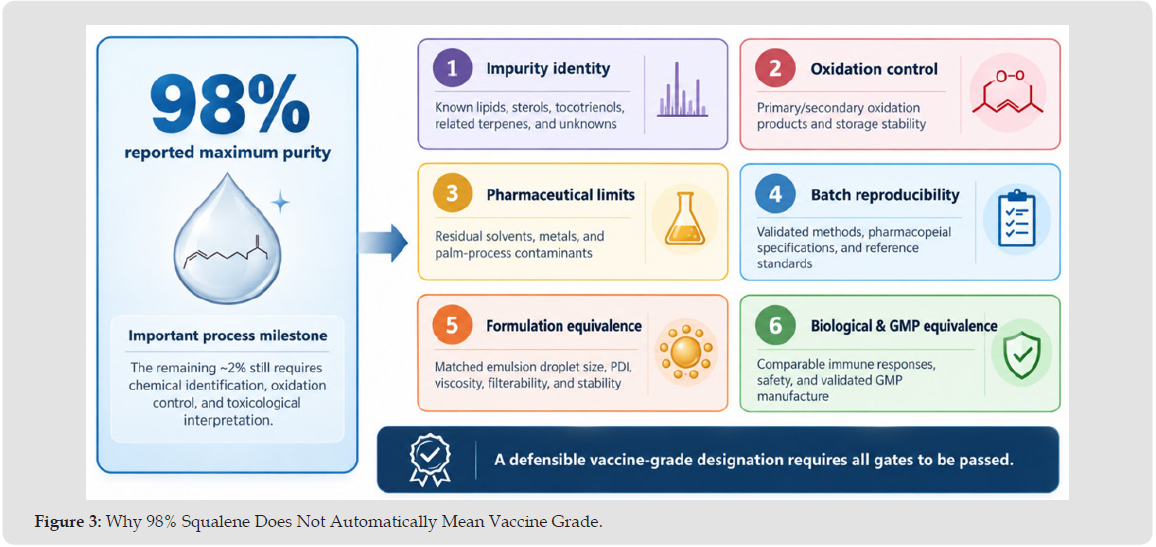
Oxidative stability requires its own specification. A candidate batch with 99% squalene but substantial oxidative degradation could be less desirable than a nominally slightly lower-assay batch with a tightly controlled degradation profile. Packaging under low-oxygen conditions, light protection, appropriate headspace management, antioxidants where justified, and refrigerated or otherwise validated storage may be necessary. Palm-specific contaminants should also be examined. Hew, et al. [37] demonstrated that refining parameters affect process contaminants such as 3-MCPD esters and glycidyl esters. Even if these compounds are not expected to co-purify substantially with squalene, pharmaceutical development should verify their absence rather than infer it. Figure 3 explains why the reported 98% purity is scientifically important but insufficient to support the label “vaccine grade.” The six qualification gates make explicit the additional evidence needed before a vaccine-grade designation would be scientifically defensible. The conceptual message of Figure 3 is that pharmaceutical grade is multidimensional. Purity is necessary, but purity without impurity identity, oxidation control, process validation, and functional comparability remains insufficient.
Figure 3
Emulsion Comparability Should Be the First Functional Gate
Once pharmaceutical analytical qualification is achieved, the next stage should be a formulation comparability study. PFAD-derived squalene should be introduced into an established or standardized oil-in-water emulsion composition, while a parallel batch is prepared using a pharmaceutical reference squalene. The comparison should examine droplet size, PDI, viscosity, pH, osmolality, density, interfacial properties, zeta potential where appropriate, filtration behavior, appearance, and chemical stability. These measurements should be performed immediately after manufacture and during accelerated and real-time storage. Phan, et al. [6] showed that process scale can substantially change viscosity and processing behavior even when the intended formulation remains constant. Therefore, comparability studies should progress from laboratory to pilot and manufacturing scales rather than assuming that small-batch equivalence persists automatically after scale-up. An important experimental result would be evidence that minor differences in PFAD-derived impurity profiles do not alter emulsion characteristics. Conversely, if PFAD batches with similar assay values produce different droplet distributions or storage behavior, that would indicate that the analytical specification is not yet sufficiently informative.
Innate-Immune Equivalence
Physicochemical equivalence should be followed by biological comparability. Early studies could use standardized cell systems and animal models to assess inflammatory signaling, cytokine and chemokine release, immune-cell recruitment, antigen-presenting-cell activation, and dendritic-cell maturation. Kim, et al. [18] provide examples of mechanistic pathways relevant to squalene emulsion responses, while Nakkala, et al. [41] show that distinct emulsions may not use identical signaling pathways despite superficial similarities. These studies support a multi-parameter approach rather than a single cytokine endpoint. The central question should be whether PFAD-derived squalene produces a biological profile falling within a predefined comparability range relative to a reference pharmaceutical squalene when all other formulation variables are matched. This design would isolate source effects from formulation-related confounding and provide a defensible basis for equivalence testing.
Adaptive-Immune Equivalence
The next level should evaluate antigen-specific adaptive immunity. Relevant outcomes include antibody titers, neutralizing capacity, affinity maturation, antibody breadth, germinal-center responses, memory B cells, T-follicular-helper responses, CD4 T-cell polarization, and CD8 T-cell responses where appropriate. Nguyen-Contant, et al. [3] demonstrate the importance of antibody quality and breadth for squalene-adjuvanted influenza vaccines, while Yoshioka, et al. [19] & Hashimoto, et al. [50] illustrate how formulation composition can influence Tfh responses and breadth of immunity. A particularly informative study would use the same antigen, same surfactant composition, same squalene concentration, and same manufacturing process, changing only the squalene source. Such a design directly addresses source equivalence rather than comparing unrelated formulations.
Toxicological Equivalence and Impurity Qualification
The toxicological question is not whether squalene itself is generally well tolerated. Decades of vaccine experience provide substantial reassurance regarding appropriately formulated pharmaceutical squalene. The more relevant question is whether PFAD-specific impurities or degradation products introduce additional risk.
Toxicology should therefore focus on both the purified material and the final emulsion. Local reactogenicity, systemic toxicity, repeat- dose effects, clinical chemistry, histopathology, and immune-mediated adverse effects would be appropriate components of a staged program. If specific PFAD-related impurities persist consistently, developers would need either to remove them or qualify them toxicologically. This is one of the reasons that driving purity from 98% toward established pharmaceutical expectations may be more practical than attempting to justify a complex residual impurity mixture.
GMP Translation
A laboratory or pilot purification method becomes pharmaceutical manufacturing only when it is transformed into a validated process. Critical process parameters for a PFAD route could include incoming residue composition, distillation temperature and vacuum, feed flow rate, column loading, silica characteristics, solvent composition, desorption rate, activated-carbon contact conditions, solvent removal, oxygen exposure, and storage temperature. Each parameter must ultimately be linked to critical quality attributes. For example, elevated distillation temperature might improve separation while increasing oxidation. Increased column loading could reduce cost but impair impurity resolution. Longer activated-carbon contact could remove color bodies while increasing product loss. GMP development would also require qualified raw-material suppliers, validated cleaning, solvent-control systems, equipment qualification, documentation, deviation handling, change control, environmental monitoring where relevant, validated analytical release methods, and formal stability programs. These controls would link batch release to process capability rather than relying on end-point testing alone. The semisynthetic process reported by Fisher, et al. [12] provides a benchmark because the authors explicitly designed later synthetic steps for GMP implementation and evaluated the final material against pharmaceutical requirements. PFAD development requires a similarly deliberate transition from separation science to regulated manufacturing.
Dose, Supply, and Manufacturing Capacity
Squalene is especially interesting from a supply-security perspective because adjuvant dose requirements are relatively small per vaccine dose, yet pandemic vaccination can involve hundreds of millions or billions of doses. Consequently, a source that appears modest in bulk chemical terms may become strategically significant if it can provide consistent pharmaceutical-grade material.
Phan, et al. [6] demonstrated that squalene emulsion manufacturing can reach multi-million-dose batch scales. Such manufacturing requires dependable upstream raw material. A diversified supply base including renewable semisynthetic, microbial, botanical, and potentially PFAD-derived sources could reduce dependence on a single production route. PFAD has a geographical advantage because palm refining is concentrated in major producing countries including Indonesia and Malaysia. This creates the possibility of establishing pharmaceutical raw-material manufacturing in regions already possessing large-scale lipid-processing infrastructure. However, such localization would require pharmaceutical-quality systems substantially beyond conventional refinery operations.
Nanomedicine as a Second Translational Market
PFAD-derived pharmaceutical squalene could have value even before vaccine qualification if it meets requirements for other pharmaceutical or nanomedicine applications. Squalenoylated prodrugs and squalene-based nanoparticles create possible demand for highly purified non-shark squalene [43,44]. This pathway could provide a staged commercial strategy. Material might first enter research-grade or carefully controlled non-parenteral applications, subsequently progress to pharmaceutical synthesis, and ultimately be qualified for vaccine-adjuvant use. However, regulatory and quality requirements would remain application dependent. The broader delivery literature reviewed by Cheng, et al. [22] suggests that squalene can function as more than an inert raw material, including roles in emulsion stabilization and lipid-delivery systems. This increases the potential value of establishing a secure high-purity renewable supply.
Comparative Assessment: PFAD versus Other Sources
A rational decision should compare squalene pathways using multiple dimensions rather than a simple “natural versus synthetic” distinction. Accordingly, source selection should integrate purity, process control, sustainability, scalability, regulatory maturity, and cost rather than privileging any single attribute. Shark-derived squalene benefits from historical pharmaceutical precedent but faces ecological and supply concerns. Botanical sources avoid shark harvesting but may have comparatively low concentrations and substantial purification requirements. Microbial production increasingly achieves high titers and offers precise process control but requires fermentation infrastructure and downstream purification. Renewable semisynthesis has already demonstrated GMP vaccine-grade capability but involves chemical transformations and specific fermentation-derived precursors. PFAD offers circularity and potentially large raw-material availability but currently lacks pharmaceutical qualification and functional equivalence evidence. The competitive landscape is therefore dynamic. Ning, et al. [30], Tang, et al. [31], and Hu, et al. [33] show that microbial productivity continues to improve rapidly. PFAD development cannot assume that its side-stream status guarantees future cost competitiveness. Its strongest strategic advantage may instead be the combination of high-volume availability, existing refinery infrastructure, sequential phytonutrient valorization, and geographic diversification of pharmaceutical supply.
Sustainability Claims Require Life-Cycle Verification
The environmental case for replacing shark-derived squalene is strong in biodiversity terms, especially in light of documented declines in shark populations [8]. Yet the sustainability of any alternative must be assessed across its own life cycle. For PFAD, relevant burdens include heat and vacuum requirements for molecular distillation, n-hexane production and recycling, silica production and disposal, activated carbon, electricity, transport, product losses, and treatment of remaining residues. An integrated palm refinery might offset some burdens through shared utilities and coproduct recovery, but this requires quantitative verification. Charoentanaworakun, et al. [55] showed in another PFAD-derived product system that techno- economic attractiveness and carbon emissions vary strongly with process configuration and energy demand. That finding is highly relevant methodologically: a side-stream feedstock can still produce an environmentally intensive product if purification is demanding. A comparative life-cycle assessment should therefore evaluate at least PFAD, shark, olive/botanical, microbial fermentation, and renewable semisynthetic squalene. Functional units should reflect pharmaceutical- quality product rather than crude squalene, because purification intensity differs markedly among sources.
Proposed Translational Validation Roadmap
Figure 4 integrates the evidence into a practical translational ladder and identifies the stages already supported by PFAD research versus those that remain largely untested. The current frontier lies around high-purity recovery, whereas downstream pharmaceutical, preclinical, GMP, and clinical levels remain the decisive evidence gaps. The readiness ladder shows that PFAD research has advanced much further in extraction science than in pharmaceutical translation. The highest-value future studies are therefore unlikely to be additional demonstrations that squalene can be found in PFAD. Research should move decisively toward impurity mapping, pharmaceutical specification, oxidation, formulation comparability, GMP manufacture, and functional testing.
Figure 4
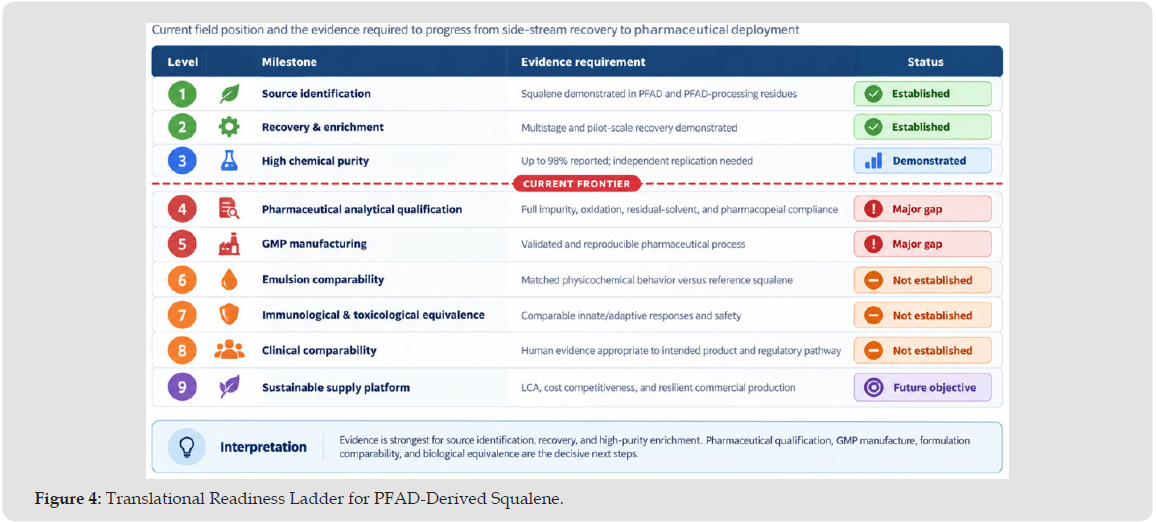
A logical immediate research program would begin with multibatch characterization. PFAD-derived squalene should be produced from multiple refinery batches, ideally across different crude-oil sources and processing histories. This would establish the true range of variation in yield, impurity profiles, and oxidation status. The second priority should be process refinement to raise purity beyond the current 98% maximum while reducing solvent and energy intensity. Alternative adsorbents, solvent-recovery strategies, supercritical technologies, or hybrid purification approaches could be explored. The objective should not simply be the highest possible assay, but the lowest cost and environmental burden capable of reproducibly meeting pharmaceutical specifications. Third, the resulting candidate material should undergo complete analytical qualification against a recognized pharmaceutical squalene reference. This should include orthogonal purity methods, unknown-impurity profiling, oxidative stability, residual solvents, metals, and contaminants relevant to palm processing. Fourth, formulation comparability should be assessed using a standard oil-in-water emulsion. The PFAD-derived batch and reference pharmaceutical squalene should be processed under identical conditions. Equivalence criteria should be predefined for particle size, PDI, pH, viscosity, chemical stability, and shelf-life behavior.
Fifth, functional testing should progress from in vitro innate-immunity assays to animal immunogenicity and toxicology. Studies should be designed as equivalence or non-inferiority experiments rather than merely asking whether the PFAD formulation generates “some immune response.” Sixth, once analytical and preclinical comparability are demonstrated, the purification sequence should be transferred into GMP manufacture. Engineering batches should assess process capability, scale effects, and control strategies. Finally, sustainability and techno-economic analysis should run in parallel rather than after pharmaceutical development. If an alternative purification configuration produces slightly lower yield but dramatically reduces solvent consumption and energy demand while still meeting pharmaceutical specifications, it may be the preferable commercial pathway.
The primary research question asked whether PFAD-derived squalene can realistically become a sustainable pharmaceutical-grade source for vaccine-adjuvant and nanomedicine applications. Current evidence supports technical plausibility but not yet pharmaceutical equivalence. Pilot-scale high-purity recovery is established, whereas full pharmaceutical qualification, GMP production, formulation comparability, and biological equivalence remain to be demonstrated.
Regarding process variability, PFAD-derived squalene composition is likely influenced by crude-oil quality, physical-refining conditions, previous phytonutrient-recovery processes, storage, and downstream separation. This variability makes source qualification and chemical fingerprinting essential. Regarding purification, molecular distillation combined with adsorption chromatography and activated- carbon polishing currently provides the strongest direct PFAD evidence. However, the use of n-hexane and energy-intensive operations creates clear sustainability and pharmaceutical-process optimization opportunities. Regarding quality attributes, a high assay alone is insufficient. Identity, related substances, oxidation products, residual solvents, metals, palm-processing contaminants, and batch reproducibility need to be integrated into a formal specification. Regarding formulation, the relevant question is not whether PFAD squalene can create a visible emulsion but whether a composition-matched emulsion behaves within the same physicochemical and stability specifications as an established pharmaceutical reference. Demonstrating such comparability would provide the first direct evidence that source-related variation has been adequately controlled at the finished-formulation level.
Regarding functional equivalence, contemporary vaccine science provides measurable innate and adaptive endpoints. There is currently no direct evidence that PFAD-derived squalene produces immunologically equivalent vaccine emulsions. Regarding GMP readiness, PFAD remains behind renewable semisynthetic squalene, for which kilo-scale GMP manufacturing and functional comparison have already been reported. That gap provides a clear roadmap rather than a reason to dismiss PFAD.
Regarding sustainability, PFAD’s circular-economy origin is attractive but does not by itself establish environmental superiority. Comparative life-cycle and techno-economic analyses are required. Regarding supply security, PFAD could eventually diversify pharmaceutical sourcing, particularly by creating a new supply node in palm-oil-producing regions. This strategic argument becomes compelling only if pharmaceutical quality and manufacturing economics are demonstrated.
Palm fatty acid distillate has moved from being merely an industrial refining side-stream containing trace squalene to a technically credible feedstock from which high-purity squalene can be recovered at pilot scale. The reported achievement of approximately 90.95% recovery, nearly 60-fold enrichment, and up to 98% purity represents a meaningful technological milestone and justifies serious investigation of pharmaceutical applications. The decisive scientific challenge now lies downstream of extraction. PFAD-derived squalene must demonstrate comprehensive impurity control, oxidation stability, analytical traceability, pharmacopeial compliance, reproducible GMP manufacture, and physicochemical equivalence in pharmaceutical emulsions. For vaccine-adjuvant use, these requirements must be followed by direct evidence of equivalent innate immune activation, adaptive immunity, toxicology, and ultimately appropriate clinical comparability. The strongest development model is therefore not “PFAD to vaccine” but a sequential source-to-function equivalence pathway: source qualification, high-resolution purification, pharmaceutical analytical qualification, GMP manufacture, formulation equivalence, biological equivalence, safety validation, and clinical translation. Renewable microbial and semisynthetic technologies provide important benchmarks because they are progressing rapidly and, in the case of semisynthetic squalene, have already demonstrated vaccine-grade GMP production. PFAD-derived squalene could nevertheless offer a distinctive strategic advantage by combining circular valorization, large-volume refinery availability, recovery of multiple high-value phytonutrients, and geographic diversification of pharmaceutical supply. If future studies establish both pharmaceutical equivalence and genuine life-cycle benefits, PFAD could become an important example of converting an agro-industrial refining side-stream into a secure and sustainable biomedical raw material.

International Association of Landscape Archaeology, Czech Glass Society, Czech Republic

Department of Chemistry, Semenov Institute of Chemical Physics, USSR Academy of Sciences, Moscow, Russia

Associate Professor at Department of Breast and Thyorid Surgey, Chongqing General Hospital, China

Professor of Nuclear Medicine, Faculty of Medicine and Surgery, University of Milan, Milan, Italy

Department of Pharmaceutical Sciences, South University School of Pharmacy, USA





 Abstract
 PDF