[email protected]
+1 (502) 904-2126
One Westbrook Corporate Center, Suite 300, Westchester, IL 60154, USA
Site Map
 ISSN: 2574 -1241
ISSN: 2574 -1241
ISSN: 2574 -1241
Received: August 21, 2026; Published: September 04, 2026
*Corresponding author: Anusha Sunder, Doctorate in Life Science/Human Nutrition, Accredited Certification in Nutrigenetics; Lead Scientist and Nutrigenetic Expert, Xcode Life Sciences, Pvt. Ltd. Chennai, India
DOI: 10.26717/BJSTR.2026.66.010374
Our body cells (nearly a trillion) are just like us, they respire, digest food, assimilate nutrients, and, excrete waste/toxic products. Their normal functioning is essential for us to be in good health. As cells perform their routine functions, they release certain by-products like homocysteine, which should be promptly cleared or recycled with the help of efficient enzymes. These enzymes require nutrients, like folate, to efficiently recycle the toxic homocysteine into an essential amino acid (methionine), through a process called methylation. A natural process called methylation keeps our body’s inflammation under control. A disturbance in this process can affect health, and relates with everyday pain-points like acne, hives, tiredness, diarrhea, stomach cramps, allergy, asthma, sleep disturbances and weight gain. The best way to identify its likelihood is through a painless genetic assessment. Right nutrients and suitable dietary recommendations can normalize this process and enhance health through inflammation control.
A delay in homocysteine clearance or recycling can trigger inflammation. And undue inflammation is linked with health disorders like obesity, high blood pressure, heart ailments, stroke, nerve problems, joint ache, accelerated skin ageing, and gut problems like irritable bowel syndrome.
The enzymes that recycle homocysteine are controlled by genes,
and a genetic report tells the innate tendencies for –
• Efficiency of methylation pathway and promptness of homocysteine
clearance
• Precise nutrient requirements for efficient methylation/
recycling of homocysteine
Unfavorable genetic changes can result in delayed homocysteine
clearance, implicating the probability of health disorders due to undue
inflammation. Each unfavorable genetic change requires a precise
nutrient for is management and this is tailor-made based on the
individual’s genetic results. Thus quickening homocysteine clearance
and counterbalancing inflammation are achievable through gene-specific
nutrients.
Inflammation control is achieved through optimal homocycteine methylation. And this relies on the expression and function of enzyme- encoding genes in the biological pathway. The following table (Table 1) explains the crucial biological pathways of homocysteine methylation, along with the core enzyme-coding genes and their precise nutrients [1-5].
Table 1: Nutrigenetics of homocysteine methylation.
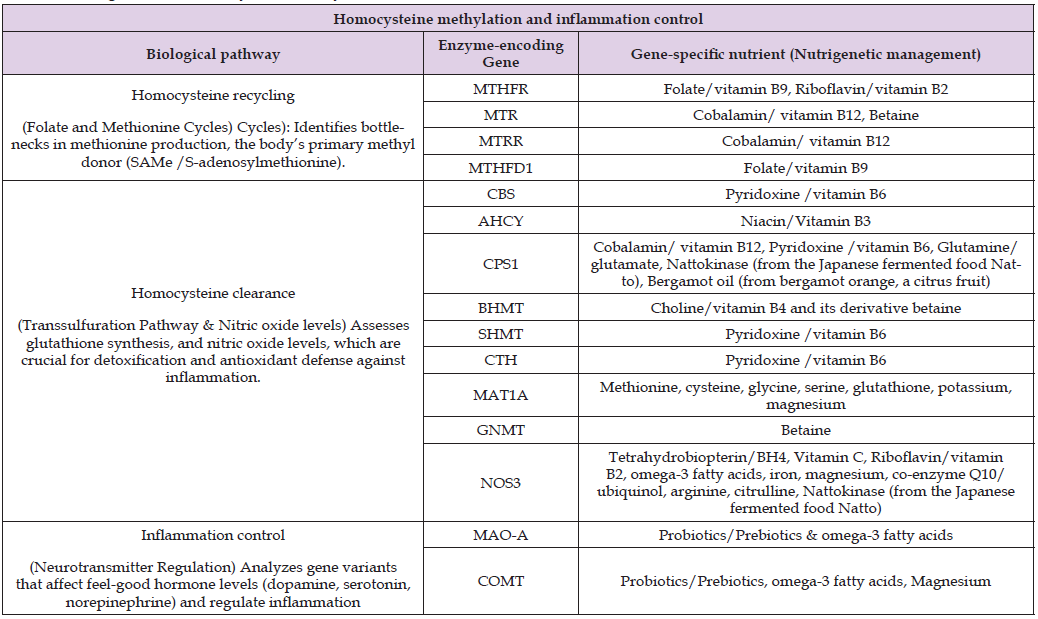
Note: The main enzyme that recycles homocysteine is MTHFR (Methylene tetrahydro folate reductase), and it is ably supported by other enzymes including MTR (methionine synthase), MTRR (methionine synthase reductase), MTHFD1 (methylenetetrahydrofolate dehydrogenase 1), CBS (cystathionine beta-synthase), AHCY (adenosylhomocysteine hydrolase), CPS1 (carbomyl phosphate synthetase), BHMT (betaine-homocysteine S-methyltransferase), SHMT (serine hydroxymethyl transferase), CTH (cystathionine-gamma-lyase), MAT1A (methionine adenosyltransferase), GNMT (glycine N-methyltransferase), NOS3 (endothelial nitric oxide synthase/eNOS), MAO-A (monoamine oxidase A), COMT (catechol-o-methyltransferase).

International Association of Landscape Archaeology, Czech Glass Society, Czech Republic

Department of Chemistry, Semenov Institute of Chemical Physics, USSR Academy of Sciences, Moscow, Russia

Associate Professor at Department of Breast and Thyorid Surgey, Chongqing General Hospital, China

Professor of Nuclear Medicine, Faculty of Medicine and Surgery, University of Milan, Milan, Italy

Department of Pharmaceutical Sciences, South University School of Pharmacy, USA





 Abstract
 PDF
PDF