[email protected]
+1 (502) 904-2126
One Westbrook Corporate Center, Suite 300, Westchester, IL 60154, USA
Site Map
 ISSN: 2574 -1241
ISSN: 2574 -1241
ISSN: 2574 -1241
Received: August 14, 2026; Published: August 27, 2026
*Corresponding author: Manuel Ojea Rúa, Professor of Educational Guidance, Co-director of the doctoral theses of PhD programme at the University of Vigo, Spain
DOI: 10.26717/BJSTR.2026.66.010362
Autism spectrum disorder can be defined as a neuropsychological developmental disorder, featuring severe limitations in information processing, especially in sensory perception and working memory, which makes it impossible to establish the necessary pathways in working memory to create episodic memory; it’s the relationship between episodic and semantic memory where context-specific recovery is facilitated. Likewise, from a behavioural perspective, it may involve limitations of differing degrees of intensity in social interaction and communication, as well as stereotyped and restrictive behaviours. This study analysed the consequences of applying the method, called by author the ‘Connectivity Theory’, aiming to assess the improvement in global academic development, specifically owing the positive correlation with to-be-attributed dependent variables, which constitute the different phases and levels of neuropsychological information processing. A total of 6 people with autism participated in this study. The data, analysed throughout 2 school years, were assessed according to the General Linear Model for Repeated Measures (4 measurements), which enabled us identify the intersection between the learning factor 1-2: “learning” and the process variables dependents. Results found through the analysis of parameter estimates showed a significant positive correlation (< .05) between the factor (codes 1 and 2) and all the dependent variables used, exception being the variable related to stereotyped and restrictive behaviours: “stereotypies” variable.
Keywords: Autism Spectrum Disorder; Neural Connectivity; Information Processing; and Applied Functional Methods
Specifically, autism spectrum disorder (ASD) is defined as a prevalent neurological condition characterised by stereotyped and restrictive behaviours and needs in communication and social interaction, ranging in intensity from mild to severe, with a score from 1 indicating a mild level, and 3 a severe level (American Psychiatric Association (APA) [1]; Centres for Disease Control and Prevention (CDC) [2,3]; National Institute of Neurological Disorders and Stroke (NINDS) [4].
Based on these institutions’ findings, the guidelines or indicative criteria for the disorder have been present since early childhood, establishing chronic and persistent indicators throughout individuals’ lives, the severity of which depends upon a wide variety of psychological, physical and environmental factors characterizing the given type of disorder. Moreover, keeping in view the functional systemic nature of the neurological system , the symptoms manifest themselves across the whole set of aspects that constitute human development, including socio-emotional reciprocity, a reduction in non-verbal communicative behaviours needed for social interaction, the development of motor coordination, understanding and participation in social interactive-communicative processes, as well as stereotyped and hyperactive motor behaviours, increasing or decreasing sensory hypo- responsiveness, which affects the neuropsychological processing of information right from the initial perceptual phase, affecting the normal functioning of the resulting cognitive abilities-both working memory, which is unable to function appropriately, as well as longterm memory and information recovery processing [5-9]. These impairments, however, should not be equated with cognitive deficits; while it is indeed valid that some people with ASD might have an intellectual disability, many others have normal intellectual functioning, or, at least, their cognitive assessments don´t fully explain the symptoms observed in the perceptual, cognitive and relational areas [10].
Limitations in neural processing inhibit the formation of inter-informative nodes, which restrict contextual understanding of the concept and, consequently, executive functions-particularly higher-order functions such as the capacity for induction and deduction, levels of conceptual analysis, generalisation and, above all, practical application – limiting oneself to a mechanical repetition of what has been learnt and an insistence on conceptual and behavioural perseveration [11,12]. A great variety of studies, based on data obtained through functional neuroimaging, reveal these aetiological hypotheses, which are specifically linked to alterations in activation, perfusion and glucose metabolism in the frontal lobes, affecting the functioning of the frontal cortex; which in turn has a decisive influence on the nodal connectional process, or the connectivity of perceptual-cognitive information, as analysed through levels of electroencephalographic coherence [13-20] are achieved by synchronising the identifying signals across different points on the head, specifically in the frontal and parietal cortex.
This research is reinforced by studies on visual, attentional and inhibitory-behavioural processes, developed by [21], both in regard to processes of hyperconnectivity [22] and to those of hypo-connectivity [23,24]. For their own part, research into the aetiology of the limitations in cortical connectivity observed in people with ASD also suggested the involvement of immunological factors [25,26], In particular, regarding to a significant reduction in the number of peripheral lymphocytes of genetic origin, even at the first stage of genetic transmission. These findings are consistent with the conclusions of studies on [27-31], which lead to the same basic conclusions based on the increase in the levels of lymphocyte subpopulations, in particular suppressor/cytotoxic lymphocytes, thereby supporting the fundamental importance of the neuropsychological functioning of information processing, which is neurologically impaired and requires specific attention to alleviate, as far as possible, these specific limitations.
In this way, the Connectivity Theory method proposed in this study is based on linking the learning-objective directly to the specific context in which the perceived concept will occur, which should be more or less linked to the conceptual processing, This allows sensory memory to gather information relating to own context, the purpose of which is to ensure that working memory is able create specific neural nodes and enhance the process of connectivity with long-term memory, not justly through a connection with semantic memory-which forms part of long-term memory-but, above all, to also create neuro- informative nodes for the formation of episodic memory, which is likewise linked to long-term memory. When doing things this way, therefore, the recovery of information is highly influenced by the context itself, enabling an appropriate response based on the educational and/or social demands of the environment, and avoiding a situation where a student with ASD answers different questions with the same generalized response. E.g., in Year 4º of secondary school, within the optional Economics discipline, the concept of inflation is associated with its context when learning about economic issues:
1. Concept (sensory memory): Inflation is a generalized increase in the prices of products, meaning that, for the same amount of money, one cannot acquire the same products or services as previously, which leads to a depreciation of the monetary unit.
2. Context (source text): In group work, with groups of 3-4 students, they experienced how a bag of 20 sweets, which costs 2 euros, but if inflation were to happen with the same 2 Euros, they would only be able to buy 15 sweets; or, to get the same bag of 20 sweets, they would now have to pay 3 Euros. This activity was carried out whilst explaining the concept and related information. The participating student with ASD will also be examined, either accompanied by their family or their own, depending on their level of autonomy, the real market prices of a specific product at different times.
The difference between this method and what is known as functional learning is that context being worked on is intrinsically linked to perception of the concept or set of concepts, employing a system able to creating the source memory associated with the reception of the stimulus or initial learning, through the presentation of a relational video or a specific musical background environment during the initial perceptual phase.
students with ASD, through the Connectivity Theory method. However, this study also assessed the 4 repeated measures of the factor; and its intersection with the dependent variables involved in the teaching-learning process allowed for the analysis and adjustment of the Semantic Integration Scale used as a measurement [32].
Research Design
The study design involved a quantitative longitudinal study performed over 2 school years, with repeated measurements every 6 months of the students with ASD included in the research.
Participants
A total of 6 students with ASD have participated in this study; 4 of them initially had a lower-middle level (code 1) of learning and 2 had an average-high level (code 2). Likewise, the study was implemented in Years 3º and 4º of secondary education, across several schools, between the years 2018 and 2020.
Variables
The independent variable (IV) or factor, named ‘learning’, means the students’ level in the school subjects in which they are receiving educational support and reinforcement; this is coded into 2 levels, based on the students’ grades: 1: lower-middle level (grades between 0 and 5) and 2: upper-intermediate level (scores academic between 5.1 and 10). The Dependent Variables (DVs), which are influenced by the method applied and assessed by following the ‘learning’ factor, are as follows: ‘conceptual’, ‘significants’, ‘category’, ‘relations’, ‘interconcepts’, ‘recovery’, ‘social’ and ‘stereotypies’, with the following coding: 0: very-low level, 2: low level, 4: medium level, 6: medium-high level and 8: high level, following the general structure of the sub-dimensions of Semantic Integration Scale (see Annex 1), although not adhering strictly to the criteria, rather using quantitative coding and extending the analysis to additional DVs 7 and 8, related to ‘social’ and ‘stereotypies’ variables.
Initial Semantic Integration Scale
Annex Table 1: SUB-DIMENSION 1: CONCEPTS

Deficits in the comprehension of conceptual units.
Annex Table 2: SUB-DIMENSION 2: MEANING

Deficits for the reconstruction of meaningful concepts.
Annex Table 3: SUB-DIMENSION 3: HIERARQUIZATION

Deficits in conceptual- categories hierarchy.
Annex Table 4: SUB-DIMENSION 4: INTER-CONCEPTS

Deficits to inter- conceptual relations development (nodes).
Annex Table 5: SUB-DIMENSION 5: NODES

Deficits to setting inter- categories relationships.
Annex Table 6: SUB-DIMENSION 6: RECOVERY

Note: Source: retrieved from Ojea M & Tellado F [18]. Semantic Integration Evaluation Scale (SIS) for children with autism spectrum disorder. Open Access
Journal of Addiction and Psychology, 1(3), 1-6. https://irispublishers.com/oajap/article-in press.php?fbclid=IwAR0o8CzRwqkkc_JuV_GWl6j49L-1rqup84YRTlZoYJo 5qJYk_O1VBYpoCoKM
Deficits to information remind.
Procedure
The Connectivity Theory method is applied within the school’s support services department, whereby small groups of students with light special educational needs-mainly those with learning difficulties or academic underachievement-are formed; these groups include one student with ASD in those academic subjects where the guidance department has recommended this support process. The necessary reports and authorisations have been drawn up for this processing.
Data Analysis
Factor (1-2) has been measured through the scores found in the subject areas in which the student experiences the greatest needs. DVs, which are influenced by the application of the teaching/learning method, have been analysed throughout 4 repeated measurements at 6-month intervals (a total of 2 academic school years). Despite the small number of participants (N: 6), were analysed by means of a quantitative study of parametric analysis, based on the General Linear Model for Repeated Measures (4), which makes it possible to determine the trajectory of their academic and social development of students with ASD [33].
Firstly, Table 1 shows the within-subjects’ factors, which make reference to the Repeated Measurements of all the DVs. It’s expected, therefore, that ‘learning’ factor – with its initial coding – will improve significantly and will interact with the 8 DVs, owing specifically to Connectivity Theory’s application (see Table 2). Effectively, the initial phase involves 4 students with ASD who have low-to-average academic and social-behavioural abilities, and 2 students with ASD who possess high-to-average academic and social-behavioural abilities (N:6). In this way, the Test for Between-Subjects Effects confirmed the levels of significance for both the interaction and the evolution of the successive measurements of the DVs (see Table 3). Similarly, the analysis of the Tests of Within-Subjects Effects (see Table 4), which indicated the level of significance of the improvement arising from the interaction between the ‘learning’ factor and the means of the 8 VDs. The analysis highlights the improvement observed in successive repeated measurements of the DVs, but most importantly, it also was shown a significant interdependence in the Assumed Sphericity test of the interaction between the DVs and the ‘learning’ factor, which suggested that educational method employed facilitates overall development, and this finding is further supported by a level of empirical statistical significance. Parameter Estimates analysis enables an examination of the different levels of the interaction between each DV and the factor (see Table 5).
Table 1: Measure: MEASURE_1.
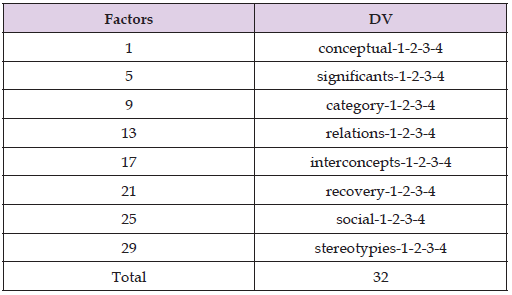
Table 2: Between-Subjects Factor.

Table 3: Tests of Between-Subjects Effects.

Table 4: Measure: MEASURE_1.

Table 5: Parameter Estimates.

As can be seen, the level of intersection between the DVs and the ‘learning’ factor, for both code 1 (lower-middle academic level) and code 2 (upper-middle academic level), showed significant changes from the previous measurement to the subsequent measurement in the intersections in the VDs ‘concepts’, ‘significants’, ‘category’, ‘relations’, ‘interconcepts’, ‘recovery’ and ‘social’, although, nevertheless, there´re differences in specific measurements from one step to the next. However, on the opposite side, no significant changes are observed in the interaction with the ‘stereotypies’ variable. This means, therefore, that parametric estimation has confirmed the validity of the method applied throughout the teaching-learning process, excluding the ‘stereotypies’ variable; although the correlation between this variable and the factor has progressively improved, it has not reached positive statistics significance, but only between measures 1 and 2 (sig.-1: .27; sig.-2: .42; sig. 3: .23; and sig. 4: .16).
The main limitation is related to the small number of students with ASD participating in the study, for which a parametric test was used, as non-parametric tests aren´t available for analysing repeated measures. However, a second limitation should also be highlighted, relating to the application of the Connectivity Theory method, which has been implemented only in those academic subjects where students performed most weakly and within the school’s support programme, whereas ideally its framework would be implemented within the mainstream educational settings for all academic discipline.
Firstly, the application of the method employed has facilitated an improvement in the ‘learning’ factor, which, by cross-referencing, has led to improvements in all the DVs, exception the ‘stereotypies’ variable, thereby improving the academic performance of all students with ASD who participated in the study. Of the 5 students, 5 have progressed to A-levels form and 1 has been chosen to undertake intermediate-level vocational training. The 5 students who undertook their A-levels have successfully completed them; of these, 3 have progressed to university degree programmes and 2 have elected to undertake a higher-level vocational training course. Hence, the Connectivity Theory approach has proven to facilitate the creation of source memory (contextual sensory memory), which, being linked to sensory perception, enables working memory to develop not only semantic memory but also episodic memory; these two forms of memory are intrinsically linked to adapting learning and, subsequently, responding adequately to demands of the context, thereby avoiding the generalised responses that people with ASD usually giving the same answer to different questions. Nevertheless, further research in this area is required in order for the ‘stereotypies’ DV to contribute to significant improvements, justly as other variables do – such as anxiety-reducing behavioural training programmes, which are integrated into the Theory of Connectivity itself and which facilitate development in people with ASD.
Intersecting with the ‘learning’ factor, which has contributed to the overall improvement observed for both factor´ “learning” to code 1 and code 2 (see Figure 1). Secondly, regarding to the second goal of this study-which focuses on the possible improvement of the Semantic Integration Scale employed to measure the DVs-this study also concluded with the inclusion of 2 sub-dimensions within the Scale as a whole, which are shown in Table 6, thereby completing the Scale in percentile terms for its analysis at a worldwide level, with all 32 items being globally interrelated. Consequently, the Semantic Integration Scale, which previously included 6 sub-dimensions, would now comprise eight subunits, the evaluation of which is determined by the percentage average score, with a diagnostic level of autism above μΣ: 50, while maintaining the structure of the three criterion dimensions indicated in the original scale: 1) Social Interaction and Communication, 2) Stereotyped and Restrictive Behaviours, and 3) Semantic Memory, based on the 3 degrees of intensity shown in that Scale (Table 6).
Table 6: Addition of 2 new subunits (7 and 8) to the Semantic Integration Scale (Ojea & Tellado [32], op. cit.).

Figure 1


International Association of Landscape Archaeology, Czech Glass Society, Czech Republic

Department of Chemistry, Semenov Institute of Chemical Physics, USSR Academy of Sciences, Moscow, Russia

Associate Professor at Department of Breast and Thyorid Surgey, Chongqing General Hospital, China

Professor of Nuclear Medicine, Faculty of Medicine and Surgery, University of Milan, Milan, Italy

Department of Pharmaceutical Sciences, South University School of Pharmacy, USA





 Abstract
 PDF
PDF