[email protected]
+1 (502) 904-2126
One Westbrook Corporate Center, Suite 300, Westchester, IL 60154, USA
Site Map
 ISSN: 2574 -1241
ISSN: 2574 -1241
ISSN: 2574 -1241
Received: August 11, 2026; Published: August 24, 2026
*Corresponding author: Frédéric Vangroenweghe, BU Food Animals, Elanco Benelux, General Lemanstraat 55/3 (Building D, 1st floor), 2018 Antwerpen, Ghent University, Faculty of Veterinary Medicine, Department of Internal Medicine – Reproduction – Population Medicine, Unit Porcine Health Management, Salisburylaan 133, 9820 Merelbeke, Belgium
DOI: 10.26717/BJSTR.2026.66.010353
β-mannans present in many vegetable feed ingredients – such as wheat, corn, barley, palm kernel meal, sunflower
meal and others – are known as strongly antinutritive polysaccharide fibres. The content of soluble β-mannans
in swine diets commonly ranges between 0.15 to 0.40%, but as little as 0.05% soluble β-mannans in feed
can elicit a strong innate immune response. Hemicell HT (Elanco AH) is a β-mannanase enzyme to supplement
animal feed, breaking down β-mannans and therefore preventing economic losses due to the wasteful immune
response elicited by these β-mannans. The current field study compared grower pig performance fed a control
diet to two reformulated diets, including a β-mannanase enzyme at 300 g per tonne of feed combined with a 45
kcal/kg or a 63 kcal/kg reduction in net energy (NE) level. A 36-day feeding trial was conducted on a commercial
grow-finishing facility with DanBred x Piétrain pigs starting at 70 days of age. Standard production data were
collected, and the data were analysed using JMP 17.1 statistical program.
Overall, pig performance did not differ significantly among treatment groups during the first phase of the grower
period. Hemicell HT had an overall benefit per grower pig of € 0.23 for a 45 kcal/kg of feed and € 0.30 for a 63
kcal/kg of feed NE reduction. The current trial demonstrated that the inclusion of Hemicell HT in reformulated
grower diets with a lower energy content (45 or 63 kcal/kg NE) was able to retain production performance in
grower pigs with an additional economic benefit.
Keywords: β-Mannanase; Grower Pigs; Net Energy Reduction; Equal Performance; Economic Benefit
Abbreviations: ADFI: Average Daily Feed Intake; ADWG: Average Daily Weight Gain; FCR: Feed Conversion Rate, NSP: Non-Starch Polysaccharide; PCV-2: Porcine Circo Virus – Type 2; PRRSV: Porcine Reproductive and Respiratory Syndrome Virus; SBM: Soybean Meal; PRR: pathogen recognition receptors; NE: Net Energy; FIIR: Feed Induced Immune Response; PAMPs: Pathogen-Associated Molecular Patterns
Polysaccharides are present in all vegetable feed ingredients commonly used in swine diets. These polysaccharides consist of polymers of monosaccharides linked by glycosidic bonds. Starch, a polymer of glucose units linked by α-(1-4) with a few α-(1-6) bonds, is digested in the small intestine of pigs through endogenous enzyme activity. Non-starch polysaccharides (NSPs), including celluloses, hemicelluloses, pectins, and oligosaccharides, are fibrous materials found in the plant cell wall. However, pigs and other monogastric animals lack the endogenous enzymes required to digest β-linked NSPs like β-mannans [1]. β-mannans are therefore considered an antinutritive factor present in many common feed ingredients [2]. These antinutritive factors have gained increasing attention in recent years. β-Mannans are built of linear polysaccharides composed of repeating units of β-1,4-mannose and α-1,6-galactose and/or glucose units attached to the β-mannan backbone [3,4]. High concentrations of these β-mannans in monogastric diets are considered unsuitable due to their antinutritive properties, which are mainly related to the stimulation of an innate immune response at the level of the intestinal lining.
The innate immune cells – the first line of cellular defense – recognize pathogens through distinct molecules, called pathogen-associated molecular patterns (PAMPs), which are expressed on the pathogen surface [5]. The pathogen recognition receptors (PRR) present on innate immune cells bind to the PAMPs, which results in the release of innate defense molecules [6]. These PAMPs include complex polysaccharides that resemble β-mannans [5]. Consequently, β-mannans that are present in the commonly used swine feed formulations are mistaken by the immune system in the gastrointestinal tract for invading pathogens. This causes unwarranted immune activation [7,8], also known as a feed-induced immune response [9]. This misrecognition of β-mannans as invading pathogens results in a futile immune response leading to a waste in energy and nutrients [3]. Inclusion of an exogenous β-mannanase enzyme can hydrolyze these β-mannans and therefore reduce and potentially eliminate their ability to induce FIIR.
In growing pigs, supplementation of β-mannanase to low- and high-mannan diets resulted in improved performance [10]. β-mannanase also improved growth performance in both weanling and grow-finishing pigs fed corn-SBM diets [11-13] with minimal effects on nutrient digestibility [12]. Moreover, innate immune activation is accompanied by downregulation of anabolic functions [14], resulting in a reduced performance capacity. Therefore, supplementation of a β-mannanase enzyme to grower diets could reduce or eliminate the occurrence of FIIR and increase available energy and proteins for growth. The objective of the current field study was to evaluate the effects of β-mannanase supplementation of grower diets with a reduced net energy (NE) content of 45 or 63 kcal/kg of feed containing a high level of β-mannans on grower pig performance and economic parameters during the first phase (0-36 days) of the grow-finishing phase.
Description of Experimental Farm
The trial was conducted at a conventional 3000-pig grow-finishing unit (Innsolpig, Knesselare, Belgium). The study consisted of a Control batch and two concurrent Enzyme-treated batches that were enrolled in May-June 2025. A total of 768 grower pigs were included in the study, of which 256 grower pigs were assigned to the Control group and 412 grower pigs to the Enzyme-treated group. Each pen housed 16 grower pigs. Compartments were ventilated through mechanical door ventilation with an air inlet through the central building corridor. All pens were equipped with partially slatted concrete floors, dry feeders, and water was distributed through nipples in the feeders. Meal feed consumption was registered at pen level. All study groups were randomly allocated to the 3 compartments enrolled during the field study to eliminate potential environmental effects among treatment groups.
Experimental Design
Treatment Groups
At the start of the grower period, the entire batch of pigs was assigned to one of the three treatment groups: Control (C) or Enzyme- treated with 45 kcal NE reduction (E-45) or Enzyme-treated with 63 kcal NE reduction, respectively. The 768 piglets were randomly assigned to one of the three treatment group considering pig weight. A total of 256 piglets were assigned to each of the three treatment gorups. The specific treatment was blinded to the farm personnel and only registered by the nutritionist at the feed mill (Voeders Ostyn, Roeselare, Belgium). Grower pigs in each separate pen were considered one experimental unit and were weighed together at the start (d0) and the end (d36) of the study period.
Experimental Diets
The composition of all experimental diets is given in Table 1. The pigs were fed a meal diet during the entire study period in each of the treatment groups. The main difference between the diets in the Control and Enzyme-treated groups was a reduction in NE content of 45 kcal/kg or 63 kcal/kg of feed (Table 1). The Enzyme-treated groups (E-45, E-63) were supplemented with a β-mannanase enzyme (Hemicell HT; Elanco AH, Indianapolis, IN, USA) at an inclusion rate of 300 g per tonne of feed, according to the manufacturer’s instructions for use. All other enzymes (xylanase and phytase) in the diets remained at the same levels in both study groups (E-45; E-63).
Table 1: Feed formulation (expressed as % of total feed) of the first phase for Control and Enzyme-treated diets with a 45 kcal/kg and a 63 kcal/kg NE reduction in Enzyme-treated diets. All major feed ingredients in both treatment groups are mentioned. Premix composition is identical in both treatment groups. β-mannan content (expressed as %), proportion of diet that was considered for calculation of β-mannan content (expressed as %), and net energy (NE) content (calculation 2015; expressed as kcal/kg feed) are given for each of the feed formulations.
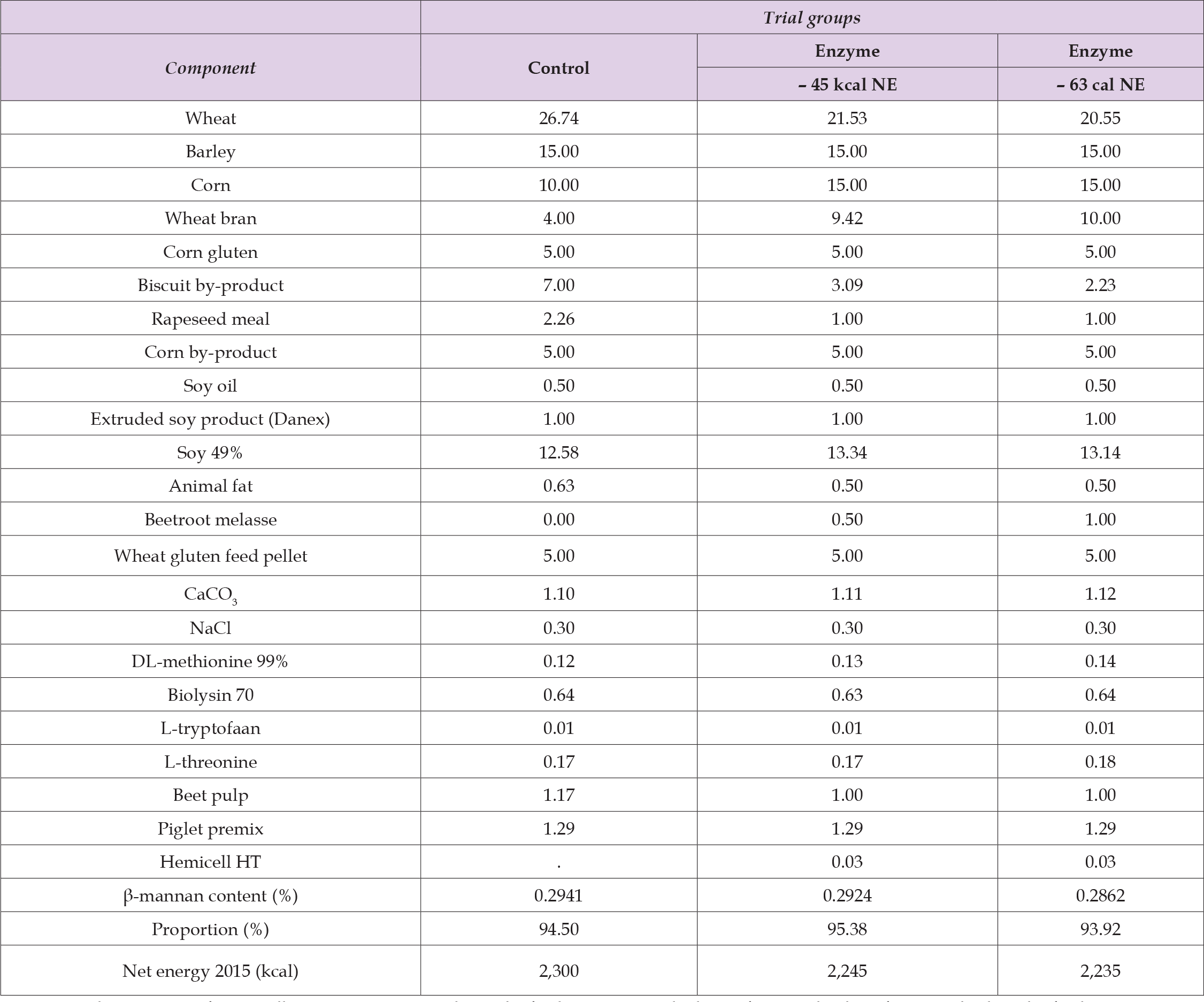
Note: *Supplementation of Hemicell HT was incorporated into the feed net energy calculation for a total value of 45 or 63 kcal per kg feed
Experimental Animals
DanBred * Belgian Piétrain grower pigs were obtained from a conventional commercial sow farm linked to the grow-finishing facility. The pigs were vaccinated to protect against (Mycoplasma hyopneumoniae), Porcine Reproductive and Respiratory Syndrome Virus (PRRSV), and Porcine Circovirus type 2 (PCV-2).
Performance Data Collection
Average pig body weight was measured at group level at 0 and 36 days. Feed provision (ad libitum) was recorded at pen level. Average daily weight gain (ADWG; expressed as g/d), average daily feed intake (ADFI; expressed as g/d) and feed conversion rate (FCR; expressed as kg feed per kg of weight gain) were calculated for the entire study period (0-36 days). Mortality was recorded along with the date of death and the number of dead animals.
Veterinary Treatments
Individual antibiotic treatments were administered as needed due to the critical state of the piglets and in case of a broader health issue in the barn (> 10% of the grower pigs affected), group treatment could be administered. The same veterinary products and dosages (ml/kg) were used throughout the entire study period. Individual antibiotic treatments or group treatments were recorded daily including the date, product, dose, ID number of treated piglets, presumed cause of treatment, and the number of times the treatment was repeated.
Economic Benefit Per Piglet and Per Tonne of Feed
The economic benefit of β-mannanase supplementation combined with a reduction in NE of approximately 45 kcal/kg or 63 kcal/ kg of feed was calculated at the grower pig level. For the calculation of economic benefit at the grower pig level, only the feed cost reduction was considered in this field trial.
Data Management and Statistical Analysis
Data were hand-recorded by the farm personnel and stored in MS Excel on OneDrive at the end of each day. Following the end of the feed trial, the data were extracted from Excel into JMP 17.1 and the blinded treatments were unblinded to reveal the respective treatment groups. Calculations, exploratory data analysis and quality review, and subsequent statistical analysis were all performed in JMP 17.1. All data were presented as a means with their standard error of the mean (SEM). All means were tested for significant differences (P < 0.05) using a T-test.
Piglet Weight
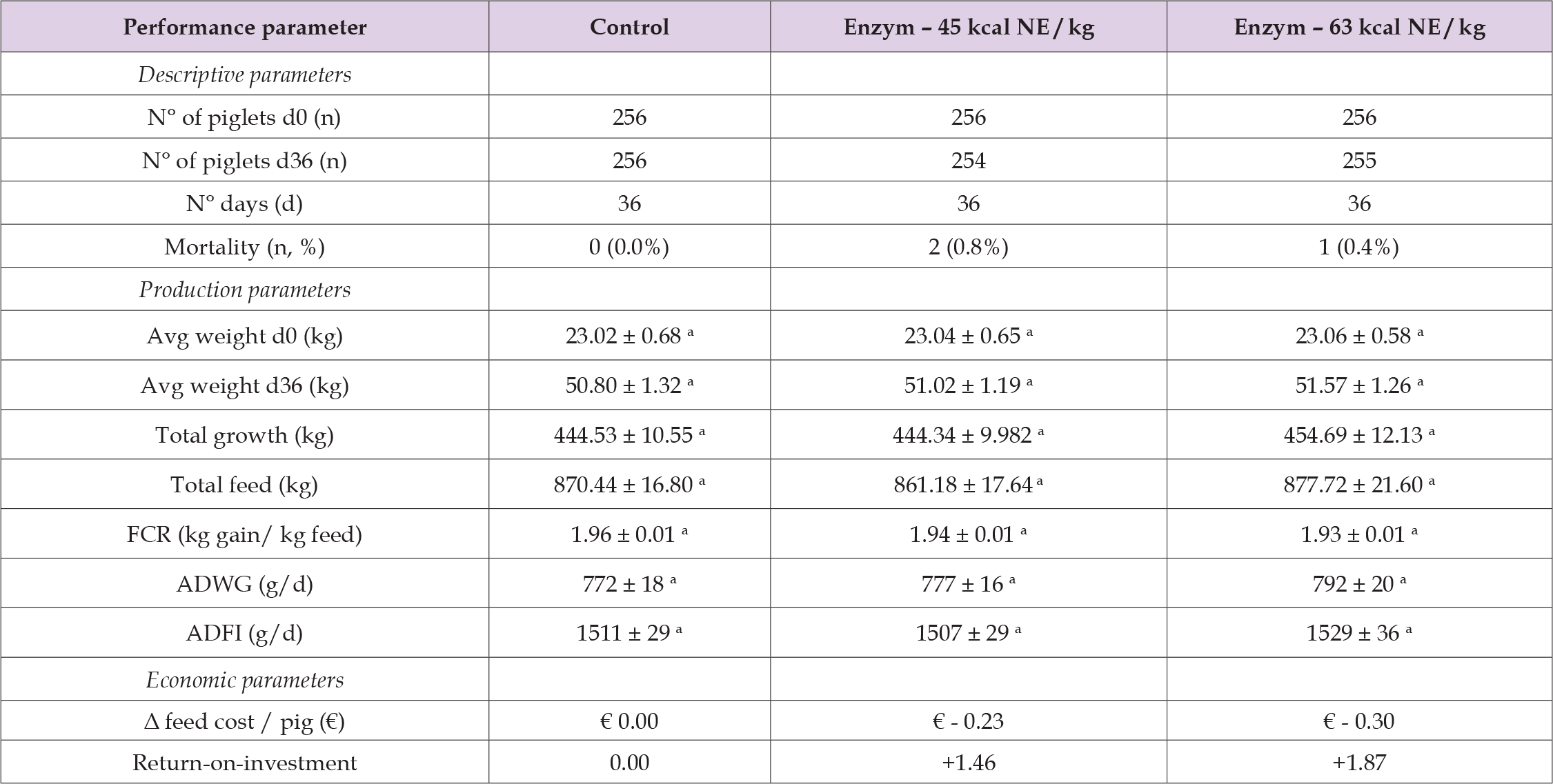
Data on weight and day in the grower period is given in Table 2. The pigs arrived at the grow-finishing facility at an average weight of 23.04 kg. There were no significant differences (P > 0.05) observed in the start weight (d0) among the treatment groups. At 36 days of age, grower pigs in the Enzyme-treated groups were only numerically (E- 45, 51.02 kg ± 1.19; E-63, 51.57 kg ± 1.26) but not significantly (P > 0.05) heavier as compared to the Control group (C, 50.80 kg ± 1.32).
Table 2: Performance data of a feed trial comparing a Control diet with two diet formulations with a reduction of net energy (NE) content by 45 and 63 kcal combined with a supplementation of a β-mannanase enzyme in the 1st phase of the fattening period. Data are means ± SEM. Significance at P < 0.05. No significant differences could be detected between the three treatment groups.
Average Daily Weight Gain, Average Daily Feed Intake and Feed Conversion Rate
Data on ADWG, ADFI, and FCR is given in Table 2. Average daily weight gain was only numerically but not significantly (P > 0.05) higher in the Enzyme-treated groups (E-45, 777 g/d ± 16; E-63, 792 g/d ± 20) as compared to the Control group (C,772 g/d ± 18). Average daily feed intake was not significantly (P > 0.05) different among the three treatment groups (C, 1511 g/d ± 29; E-45, 1507 g/d ± 29; E-63, 1529 g/d ± 36). Feed conversion rate was slightly, but not significantly (P > 0.05) higher for the Control group (C,1.96 ± 0.01 kg feed/kg gain) as compared to the Enzyme-treated groups (E-45, 1.94 ± 0.01 kg feed/kg gain; E-63, 1.93 ± 0.01 kg feed/kg gain).
Antimicrobial Treatment
No antimicrobial treatments were administered throughout the entire study period in any of the three treatment groups.
Mortality
Data on mortality is given in Table 2. Overall, mortality was slightly, but not significantly (P > 0.05) lower in the Control group (C, 0/256 – 0.0%) compared to the Enzyme-treated groups (E-45, 2/256 – 0.8%; E-63, 1/256 – 0.4%).
Economic Benefit Per Piglet and Per Tonne of Feed
Overall, supplementation of a β-mannanase enzyme combined with a reduction of NE by 45 kcal/kg of feed during the first 36 days in fattening resulted in an economic benefit per grower pig of € 0.23. For the reduction of NE by 63 kcal/kg of feed, the economic benefit was € 0.30 per grower pig. The calculated ROI of Hemicell HT based on the enzyme cost per tonne (€ 2.897/tonne) resulted in a positive value of 1.46 for the E-45 group and 1.88 for the E-63 group.
In current field trial, involving the 45 kcal/kg and 63 kcal/kg NE reduction, the β-mannan content ranged from 0.296 to 0.294% among the different dietary treatments. This calculated β-mannan content was sufficient as a substrate for the β-mannanase enzyme without the need for additional protein substitutions as previously reported [15]. Since high levels of β-mannans are known to be an antinutritive factor [2], this may stimulate an innate immune response mainly due to their resemblance with PAMPs [5]. This innate immune response is known as FIIR (Feed Induced Immune Response) [9] and can lead to an unnecessary immune activation, causing energy and nutrients to be wasted [3]. Therefore, 300 g/tonne of an exogenous β-mannanase enzyme (Hemicell HT; Elanco AH, Indianapolis, IN, USA) was added to hydrolyse these antinutritive β-mannans in the trial feed. The overall results demonstrated no significant differences in the measured (pig weight, feed provision) or calculated (ADWG, ADFI, FCR) performance parameters among the treatment groups. Besides some minor numerical differences, the overall result confirmed that the addition of an exogenous β-mannanase to adapted formulations with a reduction in NE content of 45 kcal/kg or 63 kcal/kg of feed, in the presence of a sufficient level of β-mannans, allowed pigs to perform similarly to those fed the standard grow-finishing Control diets.
These results are consistent with other recent studies in low- and high-mannan diets [10,15-18]. In addition to similar results in production performance, a substantial economic benefit of supplementation of a β-mannanase enzyme could be calculated. Based on the actual feed prices (May-June 2025) and measured feed intake, we obtained € 0.23 and € 0.30 reduction in feed per grower pig during the first phase (0-36 d) of the fattening period. Others concluded that β-mannanase improved growth performance in both weanling and grow-finishing pigs on corn-SBM diets [11-13]. A diet with a 150 kcal/ kg reduction in digestible energy supplemented with β-mannanase outperformed in weight gain and feed efficiency [11]. Overall, the results from the current grower pig trial demonstrated that in the presence of a sufficient amount of β-mannans in the diet formulations, the addition of a β-mannanase enzyme (Hemicell HT; Elanco AH) could support grower pig performances under field conditions with formulations adapted towards 45 kcal/kg or 63 kcal/kg NE reduction. The adapted diet formulation resulted in improved economic benefits of € 0.23 or € 0.30 per individual grower pig, respectively. For every invested euro in supplementation of a β-mannanase enzyme, we could show a positive ROI of +1.46 to +1.88, which make inclusion of Hemicell HT a profitable investment for pig producers to improve the net margin of their swine operations and help them remain competitive in a volatile global market.
The current trial demonstrated that the inclusion of Hemicell HT in reformulated diets with a lower energy content (45 kcal /kg or 63 kcal/kg NE) was able to retain production performance in grower pigs and be economically beneficial. The inclusion of Hemicell HT had an overall benefit of € 0.23 and € 0.30 per grower pig for the 45 kcal/ kg and the 63 kcal/kg NE reduction, respectively. This resulted in a positive ROI of + 1.46 and + 1.88 for the 45 kcal/kg and the 63 kcal/kg NE reduction, respectively.
Ethics Approval and Consent to Participate
Field trial with an EFSA approved feed supplement for use in swine. No additional ethical approval was needed. Consent to participate was obtained following full information of the farmer on the protocol to be carried out.
Consent for Publication
Not applicable.
Availability of Data and Material
The datasets analyzed during the current study are available from the corresponding author on reasonable request.
Competing Interests
The authors declare that they have no other competing interests.
Funding
The study was funded by Elanco Animal Health.
Author’s Contributions
FV is involved in study design, data collection, data analysis and manuscript preparation.
Acknowledgements
The author greatly acknowledges the swine farmer for his participation in the study.
Author’s Information
FV is currently a Principal Technical Advisor Swine & Nutritional Health for Benelux / UK&ROI within Elanco Animal Health. He holds a DVM, a Master in Veterinary Public Health and Food Safety, a PhD in Veterinary Sciences, a PhD in Applied Biological Sciences, an EBVSTM European Specialist in Porcine Health Management and a Diplomate of the American Board of Veterinary Practitioners – Swine Health Management. He has an interest in swine intestinal health and specific approaches to improve intestinal health through non-antibiotic solutions.

International Association of Landscape Archaeology, Czech Glass Society, Czech Republic

Department of Chemistry, Semenov Institute of Chemical Physics, USSR Academy of Sciences, Moscow, Russia

Pharmaco-kinetics, dynamics and Drug Metabolism, Touro College of Pharmacy, USA

Professor of Nuclear Medicine, Faculty of Medicine and Surgery, University of Milan, Milan, Italy

Clinical Radiologist (MD) - Department of RADIOLOGY, Cosenza Hospital, Cosenza, Italy





 Abstract
 PDF
PDF