[email protected]
+1 (502) 904-2126
One Westbrook Corporate Center, Suite 300, Westchester, IL 60154, USA
Site Map
 ISSN: 2574 -1241
ISSN: 2574 -1241
ISSN: 2574 -1241
Received: June 30, 2026; Published: July 23, 2026
*Corresponding author: Bryan B Whaley, Professor, Health Communication, Director, Health Studies Minor, University of San Francisco, USA
DOI: 10.26717/BJSTR.2026.66.010319
This investigation explored patient perceptions of female healthcare professionals who stutter. Participants rated a female nurse or a female physician who, when introducing herself to patients, either was fluent, stuttered and disclosed her dysfluency, or stuttered and did not disclose her dysfluency. Participants rated the doctor similarly on warmth and competence regardless of whether or not she stuttered or stuttered and disclosed it. However, when the nurse stuttered, compared to when she did not, she was rated lower on both warmth and competence. The nurse disclosing her stutter bolstered perceptions of her warmth to the same level as the fluent nurse, but perceptions of competence remained low despite disclosure. Implications for healthcare providers and suggestions for future investigations are offered.
Keywords: Stuttering; Nurse; Physician; Patients; Disclosure; Perceptions
A considerable literature suggests that fluent interactants perceive persons who stutter (PWS) negatively. For example, mothers/ parents (Crowe [1]), school teachers (Lass, et al. [2,3]), college students (Ruscello [4]), university professors (Dorsey [5,6]), special educators (Ruscello, et al. [7]), speech pathology students (Ruscello, et al. [8]), speech-language clinicians (Lass, et al. [9]), school administrators (Lass, et al. [10]), employers (MI Hurst [11,12]), store clerks (McDonald [13]), vocational rehabilitation counselors (MA Hurst [14]), college career counselors (Walker [15]), the general public (Kalinowski, et al. [16]), and nurses (Silverman [17]), attribute negative qualities to PWS. Specifically, people who stutter are often described with negative personality attributes, including being nervous, shy, tense, anxious, guarded, fearful, introverted, embarrassed, and frustrated (Bebout [18]).
This occurs regardless of fluent persons’ education, age, profession, or cultural background. Given these findings, unsurprisingly, scholars have suggested that PWS are the recipients of the most severe derision among people with communicative disabilities (Bebout [18-20]). Stuttering also affects the outcomes of interpersonal interactions. The reactions of fluent listeners to stuttering include impatience, amusement, repulsion, pity, sympathy, curiosity, surprise, and embarrassment (Bloodstein [13,21]). Also, fluent listeners may try to limit or avoid conversation with stuttering partners (Hubbard [22- 25]) and want more space between themselves and PWS (McKinnon [26]). In essence, fluent speakers report substantial uneasiness when interacting with PWS.
One percent (1%) of the population stutters, and adults who stutter still have to carry out their professional employment responsibilities. Although research concerning the effect that stuttering has on fluent interactants’ perceptions of persons who stutter in a professional context is extremely scant, stuttering can greatly affect employment options, workplace discrimination and performance (Klein [12,27-29]). These phenomena extend and apply to professionals in the healthcare context, as well. This is particularly concerning in that nurses perceive physicians who stutter as less competent, mature, intelligent, confident, educated and reputable than their fluent physician peers (Silverman [17]). However, little research has examined patient perceptions of nurses who stutter1.
How stuttering affects perceptions of nurses is important to understand because nurses comprise the majority of health care professionals and arguably interact with patients most frequently. Nurses who stutter, therefore, could be most severely affected among healthcare professionals because patients interact with them on a closer level and may, thus, be more perturbed by stuttering. In addition, because physicians tend to be perceived as higher status than nurses (Glick [33]), stuttering may undermine patient perceptions of nurses more than physicians. Some research suggests that high-status others who have flaws are actually perceived more favorably, because imperfections make an otherwise-intimidating individual seem more human and approachable (e.g., Aronson [34]). Thus, the higher status of physicians may immunize them from the anticipated adverse effects of a stutter on perceptions of physicians.
• H1: A nurse who stutters will be viewed less favorably on dependent measures than a physician who stutters
Research suggests that PWS can improve fluent speakers’ attitudes toward them by acknowledging their dysfluency, preferably early rather than later in the interaction (e.g., Healy [35]). For instance, fluent research participants rated PWS who disclosed as more friendly, outgoing, and confident as compared to PWS who failed to disclose (Byrd [36]). Silverman [37] found that fluent university research participants rated a person who stuttered wearing a t-shirt with “I stutter, so what!” more positively (e.g., better sense of humor and self-concept, brave, calm, confident, dominant, extroverted, happy, intelligent, interesting, secure, sociable, strong, talkative) than a PWS without the t-shirt. Also, a replication study of Silverman [37] using business people and clerks in stores resulted in similar findings (Silverman [38]). As such, evidence suggests that self-disclosure/ acknowledgment of one’s stuttering has profound positive impact on fluent listeners’ perceptions of the person who stutters (Lee [39]).
This leads to the following predictions:
• H2: A nurse who is fluent will be viewed more favorably on dependent measures than a nurse who stutters • H3: A nurse who discloses stuttering will be viewed more favorably on dependent measures than a nurse who refrains from disclosing her stuttering.
Participants
A convenience sample of ninety (n=90; females=64, males=26) participants were chosen at random from undergraduates attending a private west coast university. Respondents’ efforts were voluntary and responses were anonymous2.
Materials and Procedures
Participants were randomly assigned to one of six conditions in a 2 (nurse/doctor) x 3 (fluent/stuttering with disclosure/stuttering without disclosure) factorial design such that each imagined meeting either a female nurse or female physician who
(a) Introduces herself and discloses that she stutters,
(b) Introduces herself while stuttering but fails to disclose her dysfluency, or
(c) Introduces herself fluently3.
The text of the disclosure was as follows: You walk into the exam room and receptionist tells you that the nurse that will be helping you is well-trained from the top nursing school in the country. As the nurse introduces herself (while stuttering), she says “Hello, nice to meet you. I’m nurse Abigail. Before we begin, I wanted to let you know that I have a severe stutter.”
Dependent Measures
After reading the scenario, participants responded to the following dependent measures assessing their perceptions of the healthcare provider: competent/incompetent, unprofessional/professional, polite/ impolite, impersonal/personable, trustworthy/untrustworthy, and private/open on 7-point scales. Correlations between these outcome measures are presented in Table 1.
Table 1: Means, standard deviations, and correlations between dependent measures with 95% confidence intervals.
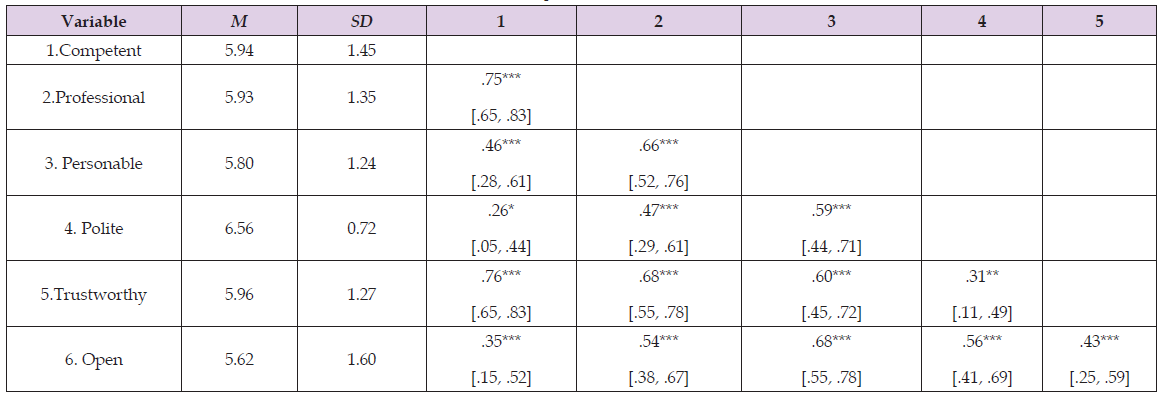
Note: M and SD are used to represent mean and standard deviation, respectively. Values in square brackets indicate the 95% confidence interval for each correlation. * indicates p < .05. ** indicates p < .01. *** indicates p < .001. This table was partially generated using the R package apaTables (Stanley [40]).
A maximum-likelihood exploratory factor analysis with oblique (i.e., promax rotation) indicated that the dependent measures clustered into two factors, one related to provider competence (3 items, α=0.89, ratings of how competent, professional, and trustworthy the provider was), and one related to provider warmth (3 items, α=0.78, ratings of how polite, personable, and open the provider was). This is in line with a large literature on social perception, which suggests that warmth and competence are two dimensions on which people immediately evaluate others when forming first perceptions (e.g., Fiske [42]). Accordingly, rating responses were averaged into two scales, one measuring provider competence and one measuring provider warmth. These two scales were moderately positively correlated with one another, r(88) =0.59, p<0.001.
Two separate two-way Type 3 analyses of variance predicting the competence scale and the warmth scale, respectively, with provider type (female physician vs. female nurse), provider stutter (no stutter vs. stutters but does not disclose vs. stutters and discloses), and their interaction as fixed effects were conducted (see Table 2 for a two-way analysis of variance table). For these analyses, one dummy code for provider role was included to omit nurses as the base group and compare them to doctors (0=female nurse, 1=female physician), and two dummy codes for provider stutter, one to omit providers who do not stutter and compare them to providers who stutter (1=stutter, 0=disclose stutter, 0=no stutter), and one to omit providers who do not stutter and compare them to providers who stutter and disclosed it (0=stutter, 1=disclose stutter, 0=no stutter).
Table 2: Two-way fixed-effects analysis of variance predicting ratings of provider competence and provider warmth with provider type (female nurse or female physician) and provider stutter (no stutter, stutters and does not disclose, stutters and discloses).
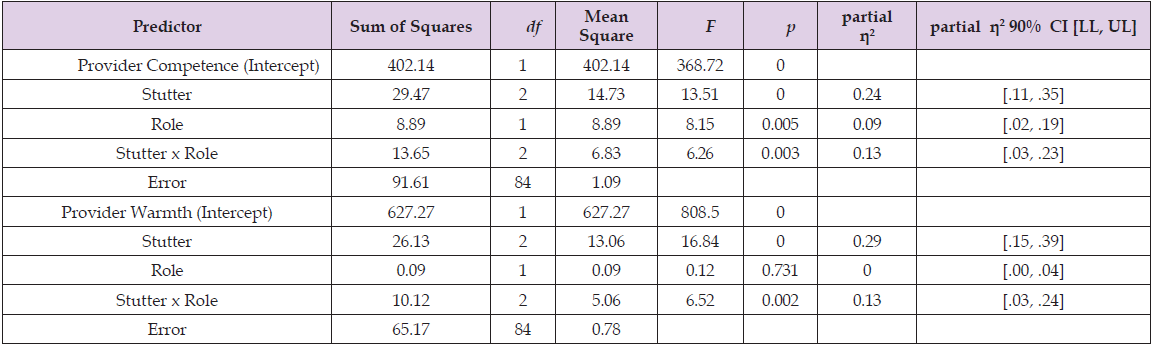
Note: LL and UL represent the lower-limit and upper-limit of the partial η2 confidence interval, respectively. This table was partially generated using the R package apaTables (Stanley [40]).
First, female providers were rated as more competent, but not more warm, when they were a physician rather than a nurse. There was a significant main effect of provider type for ratings of competence, F (2, 84) =8.15, p=0.005, η2=0.10. Collapsing across the three stuttering conditions, the female physician was rated as more competent (M=6.33, SD=0.77) than the female nurse (M=5.56, SD=1.47), 95% confidence interval (CI) of the differences in means: [0.27,1.26], t (66.472) = 3.08, p=0.003, Cohen’s d=0.65 [95% CI: 0.22, 1.08]. 4This finding is in line with the idea that physicians are perceived as higher status than nurses. There was not a significant main effect of provider type for ratings of warmth, F (2, 84) =0.12, p>0.25, η2=0.04; whether the healthcare provider was a physician or a nurse did not affect perceptions of her warmth. Next, provider fluency affected whether or not a provider stuttered affected perceptions of her competence and warmth. There was a significant main effect of provider stutter for ratings of competence, F (2,84) =13.51, p<0.001, η2=0.12.
Collapsing across provider type, the provider who stuttered and did not disclose it was rated as less competent (M=5.58, SD=1.44) than the provider who did not stutter (M=6.53, SD=0.62), 95% CI of the differences in means: [-1.54, -0.38], t(39.467)=-3.33, p=0.002, Cohen’s d=-0.86 [95% CI: -1.40, -0.32], in line with the vast literature suggesting that stuttering adversely affects perceptions of individuals’ traits. Further, the provider who stuttered and disclosed it was rated no more or less competent (M=5.72, SD=1.27) than the provider who stuttered and did not disclose it, 95% CI of the differences in means: [-0.55, 0.85], t(58)=0.41, p>0.25, Cohen’s d=0.11 [95% CI: -0.41, 0.62], and was still rated lower in competence than providers who did not stutter, 95% CI of the differences in means: [-1.33, -0.29], t(42.148)=-3.14, p=0.003, Cohen’s d=-0.81 [95% CI: -1.35,-0.27]. This suggests that disclosing a stutter did not have any benefits for the provider in restoring ratings of her competence, in contrast to past literature showing that people who disclosed their stutter were rated more positively on attributes associated with competence (e.g., intelligence). However, disclosing a stutter did appear to have benefits for ratings of provider warmth.
There was a significant main effect of provider stutter for ratings of warmth, F (2, 84) =16.84, p<0.001, η2=0.18. Collapsing across provider type, the provider who stuttered and did not disclose it was rated as less warm (M=5.40, SD=1.34) than fluent providers (M=6.17, SD=0.73), 95% CI of the differences in means: [-1.33, -0.21], t (44.72) =-2.76, p=0.008, Cohen’s d=-0.71 [95% CI: -1.25, -0.18]. In contrast, the providers who stuttered and disclosed it was rated as more warm (M=6.41, SD=0.63) than the provider who stuttered and did not disclose it, 95% CI of the differences in means: [0.47, 1.56], t(41.243)=3.75, p<0.001, Cohen’s d=0.97 [95% CI: 0.42, 1.51], and was rated no differently on warmth than the provider who was fluent, 95% CI of the differences in means: [-0.11, 0.60], t(58)=1.39, p=0.169, Cohen’s d=0.36 [95% CI: -0.16, 0.88]. Thus, disclosing a stutter appeared to eliminate the otherwise negative impact that having a stutter held for perceptions of a providers’ warmth.
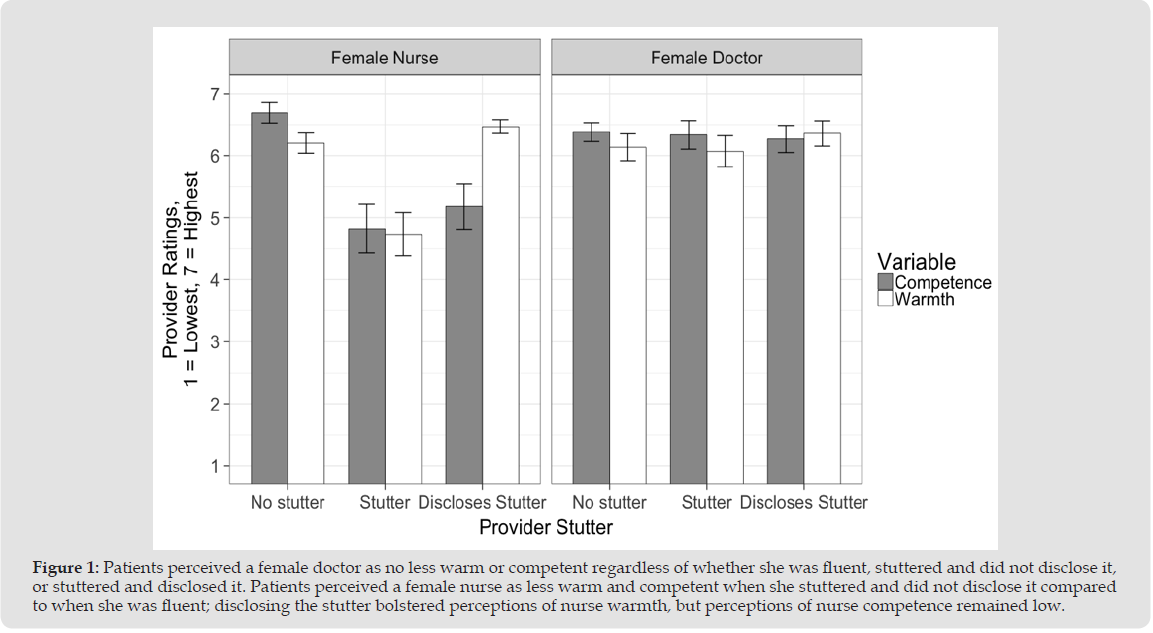
Figure 1
Provider Type
Critically, however, these procedures also revealed a significant interaction between provider type and provider stutter on the measure of provider competence, F (2, 84) =6.26, p=0.003, η2=0.10, and the measure of provider warmth, F (2, 84) =6.52, p=0.002, η2=0.11 (see Figure 1). This indicates that participants responded differently to a provider’s stutter dependent on whether or not she was a physician or a nurse. To decompose the interactions, we examined effects of the presence of a stutter first among physicians, and then among nurses. Physicians were rated no differently on warmth or competence regardless of whether they were fluent, stuttered without disclosing it, or disclosed their stutter, absolute value of all t’s<0.89, all p’s>0.25, absolute value of all Cohen’s d’s<0.33. Thus, stuttering did not affect perceptions of the physician’s warmth or competence, regardless of whether or not the physician stuttered without disclosing it or decided to disclose her stutter directly.
Among nurses, however, stuttering affected both perceptions of competence and warmth, supporting H1. An examination of simple effects via the dummy codes revealed that the nurses who stuttered was rated lower on competence than the fluent nurse, b=-1.87 [95% CI: -2.62, -1.11], SE=0.38, t (84) =-4.90, p<0.001, Cohen’s d=-1.61 [95% CI: -2.47, -0.75], thus supporting H2. And, the nurse who stuttered and disclosed it was also rated lower on competence than the fluent nurse, b=-1.51 [95% CI: -2.27, -0.75], SE=0.38, t(84) =-3.96, p<0.001, Cohen’s d=-1.38 [95% CI: -0.55, -2.21], again supporting H2. Further, the nurse who stuttered and disclosed it was rated no differently from the nurse who stuttered but did not disclose it, b=0.36 [95% CI: -0.40, 1.11], SE=0.38, t(84)=0.93, p>0.25, Cohen’s d=0.24 [95% CI: -0.51, 0.99], suggesting that disclosing a stutter did nothing to improve perceptions of nurses’ competence and in contrast with H3.
The nurse who stuttered was also rated lower on warmth than the nurse who was fluent, b=-1.47 [95% CI: -2.11, -0.83], SE=0.32, t(84) =-4.56, p<0.001, Cohen’s d=-1.40 [95% CI: -2.24, -0.57; H2]. However, the nurse who stuttered and disclosed it was rated no differently on warmth compared to the fluent nurse, b=0.27 [95% CI: -0.37, 0.91], SE=0.32, t(84) =0.83, p>0.25, Cohen’s d=0.50 [95% CI: -0.27, 1.25], supporting H3. Further, the nurse who stuttered and disclosed it was rated as much more warm than the nurse who stuttered but refrained from disclosing it, b=1.73 [95% CI: 1.09, 2.37], SE=0.32, t(84)=5.39, p<0.001, Cohen’s d=1.74 [95% CI: 0.86, 2.62], suggesting that disclosing a stutter dramatically improved perceptions of nurses’ warmth (and again supporting H3). The results, in sum, illustrate that stuttering affects perceptions of nurses (and not physicians). Physicians were rated equally warm and competent regardless of their fluency. However, nurses were rated as both less warm and competent when they stuttered. There appear to be strong stereotypes that negatively affect perceptions of nurses who stutter.
While addressing one’s stutter by disclosing it appeared to benefit perceptions of nurses’ warmth, it did not appear to fully correct for stereotypes about these nurses’ competence. Disclosing one’s stutter thus only partially improves perceptions of nurses who stutter. This indicates that participants responded differently to a provider’s dysfluency dependent on whether or not that provider was a physician or a nurse. Physicians were rated no differently on warmth or competence regardless of whether they were fluent, stuttered with no disclosure, or stuttered with disclosure. Among nurses, having a stutter affected perceptions of competence and warmth. Nurses who stuttered were rated lower on competence than nurses who were fluent, and nurses who stuttered and disclosed it were also rated lower on competence than nurses who were fluent. Further, nurses who stuttered and disclosed were rated no differently from nurses who stuttered but did not disclose it, suggesting that disclosing a stutter did nothing to improve perceptions of nurses’ competence of the nurses with dysfluency. Nurses who stuttered were also rated lower on warmth than nurses who were fluent. However, nurses who stuttered and disclosed it were rated no differently on warmth compared to fluent nurses.
The present investigation makes several novel contributions. First, it is the first study to examine the effects of dysfluency on patient perceptions of healthcare providers. Second, this study tested whether a provider disclosing her stutter altered these perceptions, countering any negative impacts of stuttering. Several of the findings of this investigation are of interest and importance for the literatures on communication, communication disorders, and social perception. These findings also have applied implications for interactions in healthcare. Results indicated that among physicians, stuttering did not affect perceptions of either competence or warmth. This is an extremely positive advance in its own right, given the large literature suggesting that physicians should have been perceived more negatively on the basis of stuttering. However, nurses who stuttered were perceived as less warm and competent by patients. This suggests that occupational status may affect how individuals respond to health professionals who stutter. This finding has important implications for nurses, in that they perform the majority of the provider-patient interaction.
Further, among nurses, disclosing one’s dysfluency failed to improve perceptions of competence, but enhanced perceptions of interpersonal warmth. Specifically, nurses who disclosed their stuttering were rated as more warm than non-disclosing nurses, and equally warm to fluent nurses. This finding supports and supplements the literature concerning the impact of dysfluency disclosure, especially in the initial phase of social interaction. It suggests that disclosure may not improve perceptions of all attributes, but perhaps sometimes selectively bolsters warmth and not competence. Future research could explore whether other types of disclosure might enhance perceptions of both warmth and competence for nurses. As with all investigations, this initial study has some important limitations. This study was a hypothetical scenario that used one specific type of interaction, namely a healthcare professional introducing themselves and disclosing their stutter prior to any purposeful interaction. Subsequent inquiries could consider the effect of stuttering and disclosure when favorable (i.e., good news) versus unfavorable (i.e., bad news – serious diagnosis) information is shared, social support is offered, or when a compliance attempt is made by the health professional concerning medical regimen.
Engaging in interaction with a nurse who stutters (especially with no disclosure) may affect perceptions more dramatically, given the often-noted frustrations by fluent speakers (Whaley [44]). Also, a nurse’s dysfluency may disrupt or impinge on patients’ message processing due to the distraction. Investigations employing information recall and cognitive responses (i.e., thought-listing) would provide critical insight into the effects of stuttering in social interaction. From this investigation, there appears to be some progress made in that not all professionals are perceived negatively when they stutter. People who stutter exhibit a difference in speech prosody. Other than this variation in timing of speech production, research indicates that PWS are alike in every manner to fluent speakers (e.g., Bloodstein [21,45,46]). As such, there is still work to be done to alter fluent speakers’ perceptions of PWS (Boyle [47]). In the meantime, exposing the public and health care professionals to the interaction strategies that PWS prefer that fluent speakers use when conversing with them would prove beneficial for all (Whaley [24]).
1Stuttering has been discussed in the nursing literature concerning their patients who stutter (i.e., Karlin, et al. [30,31]). See Yano, et al. [32] for discussion of how stuttering affects nurses’ workplace identities.
2All data collection and participant protection procedures corresponded to the IRB guidelines at the first author’s institution.
3The effects concerning sex differences and perceptions of persons who stutter are unclear (see Bajaj, et al. [40,36]). Therefore, to avoid potential confounds or interaction effects concerning sex of health provider with this initial investigation, and that female nurses far outnumber male nurses, this study uses a female provider (nurse, physician).
4For some t-test analyses, Bartlett tests of homogeneity of variances indicated that the groups’ variances were not equal, all Bartlett’s k2’s>10, all p’s<0.002. When a Bartlett test indicated heterogeneity of variance, we conducted a Welch two-sample t-test, which corrects for heterogeneity of variance by using the Welch (or Satterthwaite) approximation to the degrees of freedom, to compare the means of these two groups. Accordingly, where degrees of freedom for t-tests include decimal places, a Welch two-sample t-test was conducted. Note that a Welch two-sample t-test is a more conservative and reliable test of hypotheses (e.g., Ruxton [42]) and thus we include these analyses in the manuscript; however, results are not affected when Student’s t-tests (i.e., without the correction for heterogeneity of variance) are conducted.

International Association of Landscape Archaeology, Czech Glass Society, Czech Republic

Department of Chemistry, Semenov Institute of Chemical Physics, USSR Academy of Sciences, Moscow, Russia

Associate Professor at Department of Breast and Thyorid Surgey, Chongqing General Hospital, China

Professor of Nuclear Medicine, Faculty of Medicine and Surgery, University of Milan, Milan, Italy

Department of Pharmaceutical Sciences, South University School of Pharmacy, USA





 Abstract
 PDF
PDF