[email protected]
+1 (502) 904-2126
One Westbrook Corporate Center, Suite 300, Westchester, IL 60154, USA
Site Map
 ISSN: 2574 -1241
ISSN: 2574 -1241
ISSN: 2574 -1241
Received: February 20, 2026; Published: March 03, 2026
*Corresponding author: Jia Ping Wu, Department of Medical Technology, Shaoguan University, No. 288, Daxue Road, Zhenjiang District, Shaoguan City 512005, Guangdong Province, China P.R.C.
DOI: 10.26717/BJSTR.2026.64.010119
Dementia is an irreversible form of degenerative Alzheimer’s disease. Especially, Alzheimer’s disease and liver cancer postoperatively will cause dementia in patients. There is no clear clinical evidence to indicate whether this phenomenon is related to surgery. Therefore, we collected data on NAFLD cancer resection patients with Alzheimer’s to assess the risk of dementia from 2023 to 2026. In this retrospective cohort study, we used the univariate and multivariate Cox regression analysis and a logistic regression model to estimate the hazard ratios of dementia, with the variables being Alzheimer’s liver cancer patients after surgery. Calculated the risk of the hazard ratios (HR) of dementia for Alzheimer’s disease across different ages after surgery for age. A total of 300 liver cancer patients, according to NCCN guidelines, 103 (85.83) patients are at a very high risk of the relationship between NAFLD, and 10 (5.56) are at a high risk. The mean age of Alzheimer’s was 73.23±4.53 years at surgery. 51 (45.13%) Alzheimer’s had a Univariate HR of dementia (HR 18.42, 95% CI 11.28-27.37, p=0.03). Multivariate HR (HR 14.46, 95% CI 3.75-16.23, p=0.043) for NAFLD liver cancer at very high risk and hepatectomy multivariate HR (HR 13.57, 95% CI 4.56-16.86, p=0.047) for dementia group in detectable Alzheimer’s dementia liver cancer patients after surgery. Thus, we suggest that NAFLD to liver cancer after partial hepatectomy resection has a higher risk of dementia in Alzheimer’s disease.
Keywords: Dementia; Alzheimer’s Disease; Non-Alcoholic Fatty Liver Disease; Surgery; Age, Partial Hepatectomy
Abbreviations: HR: Hazard Ratios; WHO: World Health Organization; NAFLD: Non-Alcoholic Fatty Liver Disease; NHIRD: National Health Insurance Research Database; MMSE: Mini Mental State Examination; SD: Standard Deviation; CI: Confidence Intervals; HR: Hazard Ratio; PIVKA-2: Protein Induced by Antagonists-2
Dementia is a decline in cognitive function that includes problems with thought processing, judgment, reasoning, memory, communication, and behavioral control that have an impact on a person’s ability to live a normal life. The most common cause of dementia is Alzheimer’s disease or non-Alzheimer’s [1]. We hypothesized that Alzheimer’s patients are at a higher risk of developing dementia after liver surgery. Recently, some reports demonstrated that those who have had cancer have a lower risk of developing Alzheimer’s disease. Some proteins from cancer cells, which interact and attract the attention of immune cells can penetrate the brain and bind to the molecules that make up the characteristic brain plaques of Alzheimer’s disease, which then degrade the plaques, thereby reducing the risk of developing Alzheimer’s disease [2]. However, the patient’s liver cancer can be surgically removed, and the 5-year recurrence rate of liver cancer is as high as 70% after surgery, and the recurrence is related to dementia factors [3]. According to the World Health Organization (WHO) data, non-alcoholic fatty liver disease (NAFLD) is the most common primary liver cancer, and partial liver resection is considered a potential curative option [4]. In addition, NAFLD has been modestly associated with increased rates of dementia. Dementia is a disease that occurs with Alzheimer’s disease, which is very difficult to identify and problematic, especially because of neurodegeneration or after surgery.
This was among patients who had a modest association with NAFLD diagnosed with dementia risk [5]. Non-Alzheimer’s with dementia after surgery varies widely depending on age, anesthesia type, or dementia groups [6]. The risk effect of NAFLD after surgery for liver cancer on the risk of dementia in Alzheimer’s patients. The neurodegenerative dementia disease of Alzheimer’s disease is different from the non-Alzheimer’s vascular dementia disease after liver resection surgery for liver cancer [7]. Therefore, this retrospective study was conducted to evaluate the impact of nonalcoholic fatty liver disease (NAFLD) disease with non-Alzheimer’s disease in the analysis of highrisk liver cancer diseases in the NCCN Patient Guidelines for high-risk liver cancer diseases, and to evaluate the impact of interaction disease after liver resection [8]. Alzheimer’s dementia, becoming the phenomenon of dementia or certain anesthetics promote the precursor of dementia instead of normal aging in non-Alzheimer’s patients, is a challenge to treat, and the most effective way is to prevent it, but it is often not easy to find delayed treatment.
Participant Patient Data Collection Sources
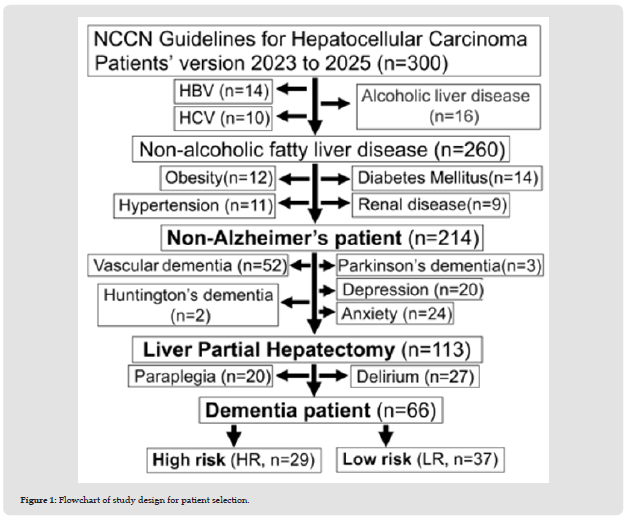
The current study was conducted on the relationship between Alzheimer’s and dementia after liver cancer partial hepatectomy surgery outcomes. Between Jan 2023 to Jan 2026, 300 participants were enrolled survey in this population collection according to the American National Comprehensive Cancer Network (NCCN). Among these, 300 participants were studied and stratified into disease history, baseline tumor characteristics, and medical data on disease recurrence into a very high-risk and a high-risk group according to NCCN guidelines. The retrospective cohort study was conducted by participants who collected data from the Taiwan National Health Insurance Research Database (NHIRD) and Shaoguan City Medical University between 2023 and 2026. All the data were from 300 liver cancer participants classified by NCCN guidelines into two groups: 120 participants at a very high-risk group and 180 participants at a high-risk group. Exclude HBV, HCV, and Alcoholic liver disease total of 40 persons. We analyzed retrospective survey data of 260 non-alcoholic fatty liver disease (NAFLD) participants who underwent liver partial hepatectomy surgery in the past 6.5 years. Of 214 Alzheimer’s liver cancer participants were treated for surgical resection for patients with NAFLD, 113 underwent hepatectomy with surgery, and 101 Alzheimer’s participants were without surgery. In this retrospective study, we assessed the risk of dementia in the past with surgery outcomes, focusing on NAFLD cancer with Alzheimer’s surgical outcomes and after hepatectomy, 66 patients were detected with dementia (Figure 1), which were MMSE (Minimum Mental State Examination) factors in this study.
This retrospective cohort study was based on Shaoguan University, Guangdong Province in China. Between Jan 2023 to Jan 2026, all the examination questionnaires were designed in advance by Shaoguan University Medical College. The patient’s medical data were accessed through the College outside interview records, as well as telephone and electronic mail surveys.
Outcomes
The outcomes of the study were the Alzheimer’s patients’ NAFLD liver cancer population relationship risk, to detect the hazard ratio for Alzheimer’s cancer patients after surgery in different older ages with Alzheimer’s-associated dementia risks. The main outcome of this study was the incidence and risks of dementia after Alzheimer’s surgery. All dementia incidents were identified by questioning the patients after surveys. The variables we collected included the following: demographic data of the elderly: age (≤54 years, 55-59 years, 60-64 years, 65-69 years, 70-74 years, 75-79 years, 80-85 years). Liver partial hepatectomy surgery (yes or no), extended PLND (yes or no), tumor TNM stage (yes or no), Surgery (yes or no), and physical condition: Alzheimer’s disease (yes or no), smoking (yes or no), anxiety (yes or no), hypertension (yes or no), hyperlipidemia (yes or no), depression (yes or no), peripheral artery disease, rheumatologic disease (yes or no), diabetes mellitus (yes or no), renal disease (yes or no), chronic pulmonary disease (yes or no), chronic heart failure (yes or no), and chronic liver disease (yes or no). Necessary examinations, such as the Mini-Mental State Examination (MMSE), were performed during the follow-up surveys evaluation. Gender, Age, Diabetes Mellitus (high blood sugar), Obesity (overweight), Renal disease, Hypertension (high blood pressure), Hyperlipidemia, Depression, Peripheral artery disease, Rheumatologic disease, Chronic lung disease, Myocardial infarction, AIDS. smoking, alcohol, physical inactivity, social isolation, Alzheimer’s, and depression were recorded.
Statistical Method
NAFLD to Liver cancer patients’ characteristics of normal distribution were described according to the SKEW test by using Excel version software checked. The normal distribution was presented within the NCCN guideline NAFLD cancer risks cohort study to descriptive statistics. The age data and PIVKA-II(mAU/mL) are a normal distribution that was presented as mean and standard deviation (SD), and number and percentage for categorical data. Analysis of variance differences between groups’ means and categorical variables percentage were analyzed by an independent two-tailed student’s t-test for the variables. Alzheimer’s NAFLD to liver cancer and dementia multivariate mixed models accounting for patient clusters in identified by questioning the patients were fitted to ascertain the association of after surgery with the outcomes: age, surgery, anesthesia, hypertension, hyperlipidemia, depression, peripheral vascular disease, rheumatologic disease, diabetes mellitus, renal disease, and logistic regression models for postoperative outcomes and surgical outcomes, with propensity hazard ratio for Alzheimer’s patients after surgery for age and dementia type. Cox regression models were used to estimate the univariate and multivariate hazard ratio (HR) for dementia groups in detectable Alzheimer’s patients by logistic regression analysis, and 95% confidence intervals (CI) of the risk of age. The two-tailed student t-tests were regarded as a p-value of <0.05, <0.01, statistically significant levels of data management, and statistical analyses were conducted using SAS version 9.4 software (SAS Cary, NC, USA). The tumor TNM stage was retrospective determined by survey participants (Figure 1).
Figure
Patient Characteristics
Participants joined the study from Jan 2023 to Jan 2026 and were followed up with interviews until Jan 2026. 300 patients were studied, and medical data on disease history, baseline tumor characteristics, and disease recurrence were stratified into risk groups according to NCCN guidelines. Patients’ medical data were accessed through external interview records, telephone and email medical surveys. All questionnaires were designed by Shaoguan University Medical College. This retrospective cohort study is based on Shaoguan University in Guangdong Province, China. Some of the data for this study are from Taiwan’s National Health Insurance Research Database (NHIRD) from January 2023 to Jan 2026. This population collected 300 patients with NCCN guidelines of liver cancer, and NAFLD disease history accessed retrospective by dementia risks interview records using telephone or email medical surveys according to MMSE records (Table 1). Thus, we hypothesized that there is a very high risk of developing liver cancer after surgery. To assess the risk values between patients with non-alcoholic fatty liver disease with liver cancer at baseline. NAFLD is caused by cirrhosis, and its risk factors include advanced age and PIVKA- II. There were 300 patients included in this analysis. The patients had a mean ± SD age (years) at very high-risk (74.78 ± 1.22 years) and high-risk (72.34 ± 1.17 years). There was significant difference in the association between very high-risk and high-risk displayed by the 70 to 75 older age groups. Of 103 (85.83%) patients have a very high risk of NAFLD (p=0.006), and of 115 (95.83%) patients have a very high risk of extended PLND (p=0.005), and of 71 (39.44%) patients have a high risk of standard PLND (p<0.01). The tumor TNM stage was the pathology stage.
Table 1: Baseline characteristics of liver cancer patients according to NCCN guideline relationship pre-operative characteristics between veryhigh- risk and high-risk outcome.
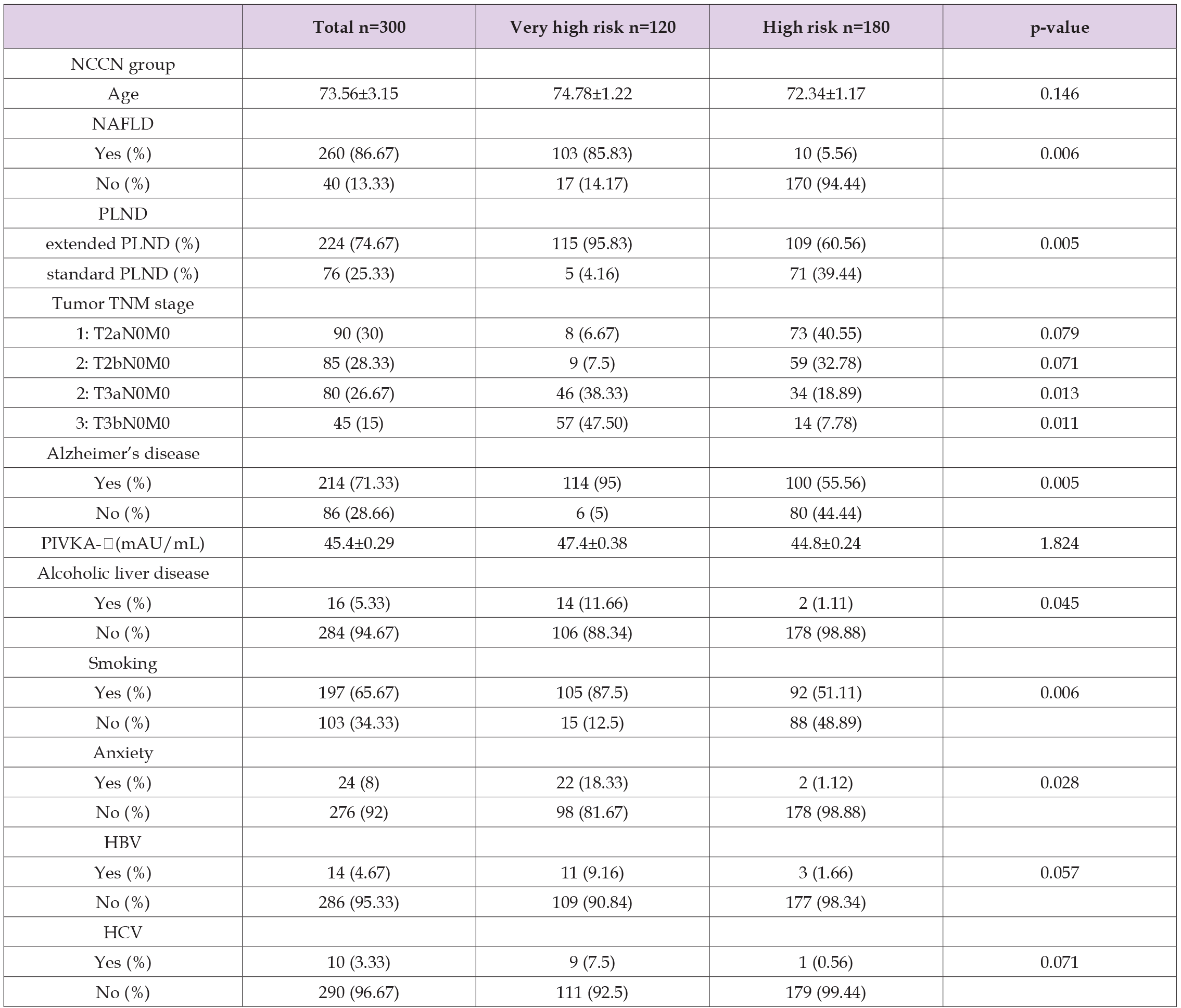
Note: PH, partial hepatectomy; PIVKA-II, Protein induced by Vitamin K absence or antagonists-II; PLND, pelvic lymph node dissection; HBV, Hepatitis B; HCV, Hepatitis C; Categorical data are presented as n (%) and performed by the student t test; continuous data with normal distribution are presented as mean ± SD.
T2aN0M0 (p=0.079) and T2bN0M0 (p=0.071) were at high risk. The patients in stage T3aN0M0 had 46 (38.33%) patients at the very high risk (p=0.013), however, 34 (18.89%) patients were at high risk. T3bN0M0 has a significant difference in at very high-risk than the very high-risk group (p=0.011). Of 114 (95%), Alzheimer’s disease was at a very high risk (p=0.005). The likely incidence of liver cancer due to nonalcoholic fatty liver disease increases with PIVKA-II(mAU/mL) until it reaches an above dose of 31 (mAU/mL). According to our results, we found PIVKA-II(mAU/mL) was at very high risk (47.4±0.38) and at high risk (44.8±0.24), both are higher than a dose of 31 (mAU/mL) as liver disease. Alcoholic liver disease (11.66%, p=0.045), HBV (9.16%, p=0.057), and HCV (7.5%, p=0.071) were at high risk of liver cancer. Of 105 patients (87.5%), have very high risk of smoking (p=0.006), and of 22 (18.33%) patients, have very high risk of Anxiety (p=0.028) (Table 1).
The Characteristics of Surgery and Non-Surgery After Hepatectomy Operations in Alzheimer’s Disease
A total of 113 patients who underwent surgery were included in this study, and their baseline characteristics are summarized. The following risks are for patients who were diagnosed with dementia and underwent surgery. The mean age of patients with surgery was 73.23 ± 4.53 years. 72 (63.72%) of males and 41 (36.28) of females showed a significant difference between the male and female groups. The possibility of dementia after surgery in Alzheimer’s cancer patients were 72 (63.72) male, 94 (83.19) hyperlipidemia, 93 (82.30) depression, 95 (84.07) peripheral artery disease, 96 (84.96) rheumatologic disease, 81 (71.68) chronic lung disease, 101 (89.38) myocardial infarction, 76 (67.26) AIDS (Table 2, all p<0.01). A retrospective cohort study for the possibility of progressive dementia after surgery operations was conducted in Alzheimer’s NAFLD cancer (Table 2).
Table 2: The patients with Alzheimer’s cancer patients for detected dementia risks.
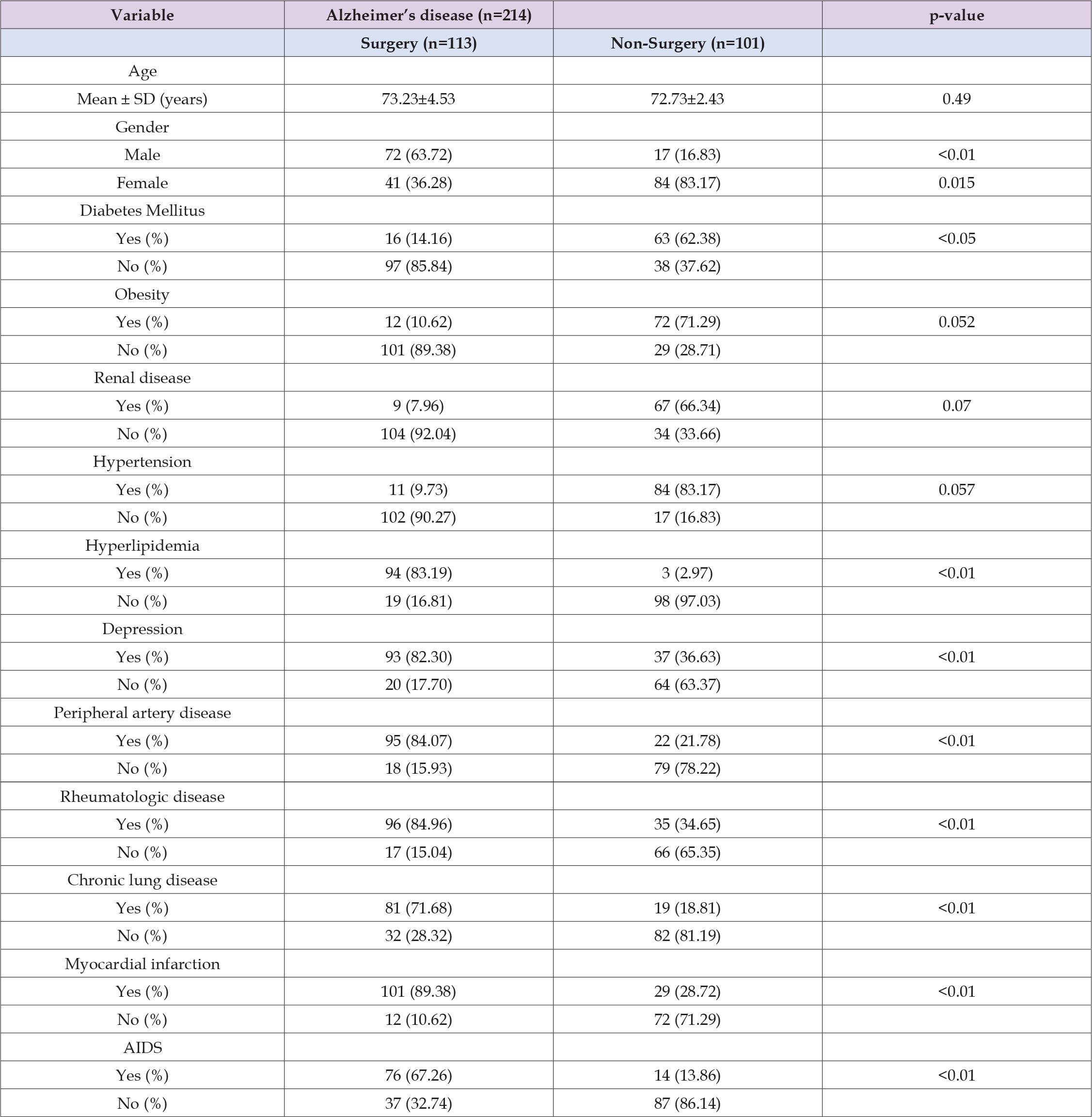
Note: Abbreviation: AIDS, Acquired immune deficiency syndrome. Categorical data are presented as n (%) and performed by the student t test; continuous data with normal distribution are presented as mean ± SD. p<0.01, p<0.05 significant values are shown.
The Hazard Ratio (HR) for Alzheimer’s Patients After Surgery in Different Older Ages
Distribution of dementia in different age groups after surgery. We assessed patients with dementia hazard ratio for Alzheimer’s patients after surgery at different older age groups (Table 3). It’s estimated that 214 of Alzheimer’s patients ages 54 to 85 have 113 received surgery, and 101 have not received liver partial hepatectomy. In this cohort study, we used the Cox regression analysis to analyze hazard risk of dementia with age after surgery. Logistic regression analysis was performed on the influences of age variables on postoperative dementia in patients who underwent surgery. According to the Table 3 result of the survey, the prevalence of dementia after surgery is one person (0.88%) for ≤54 years old, 2 persons (1.77%) for 55~59 years old, 9 (7.96%) for 60~64 years old, 19 (16.81%) for 65~69 years old, 51 (45.13%) for 70~74 years old, 28 (24.78%) for 75~79 years old, 3 (2.65%) for 80~85 years old. The Cox regression models were used to estimate the hazard ratio (HR) and 95% confidence intervals (CI) of the risk of age. The hazard ratio (HR) and 95% confidence intervals (CI): 70~74 age (HR, 18.42; 95% CI, 11.28~27.37, p=0.03), 75–79 age (HR, 32.63; 95% CI, 21.61~49.18, p=0.02), and 80–85 age (HR, 46.47; 95% CI, 37.34~84.81, p=0.01) (Table 3). Alzheimer’s patients after surgery at ≤54 years old and at 55~69 age have no significant difference in the surgery group. Of 51 (45.13%) Alzheimer’s patients after LPH surgery at 70~74 years old have a significantly higher percentage than those without surgery at other ages (p<0.01), with an estimated total of 214 people with Alzheimer’s, and of 51 people with surgery have a higher dementia hazard rate at 70~74 years old (Table 3). As we age, the growing severity of NAFLD makes the signs of Alzheimer’s disease more severe. The outcomes of the study were the NAFLD cancer patients’ hazard ratio for Alzheimer’s dementia after surgery at different ages (Table 3).
Table 3: The dementia hazard ratio for Alzheimer’s patients after surgery at different older age groups.
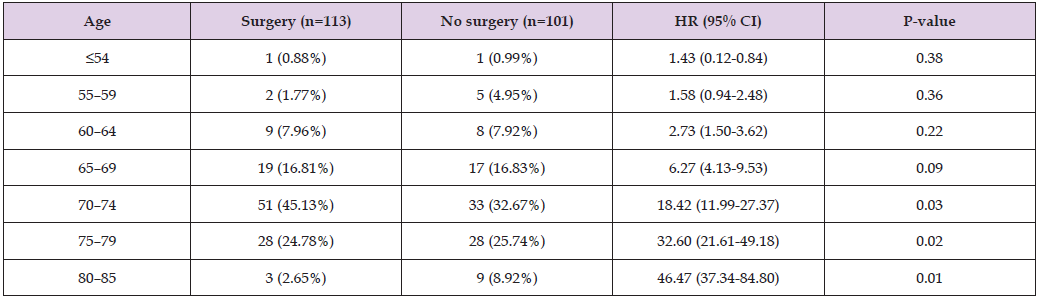
Note: Abbreviations: HR, Hazard ratio; CI, Confidence interval; LPH, Liver partial hepatectomy. Categorical data are presented as n (%) and performed by the student t test; continuous data with normal distribution are presented as mean ± SD. Significant values showed in p<0.05 and p<0.01.
Alzheimer’s Liver Cancer Patients After Surgery with Dementia Univariate and Multivariate Hazard Ratios (HR)
In this study, we used the univariate and multivariate Cox regression analysis to analyze the hazard rations of dementia at the very high risk of surgical procedure, age, hepatectomy, extended PLND, APP density, pathology tumor percentage, and non-Alzheimer’s dementia. Logistic regression analysis and validation were performed on the influences of various variables on postoperative dementia who underwent surgery. In univariate HR (95% CI) analysis, this translated to an HR of 2.43 (95% CI 1.28-3.24) for dementia associated with Alzheimer’s NAFLD cancer after surgery relative to very high risk (vs high risk). The association of the hazard ratios of dementia risk between dementia and Alzheimer’s NAFLD cancer after surgery was attenuated by univariate Cox regression analysis for at Very high risk, Age, Surgery, Hepatectomy, extended PLND, APP density, Pathology tumor percentage, non-Alzheimer’s dementia (Parkinson’s disease, Depression, Anxiety, and Huntington’s disease) were associated with no significant increase in the risk for 95%CI. However, the multivariate analysis of HR (95% CI) for dementia patients was detectable in Alzheimer’s NAFLD cancer after operative at very high risk (vs high risk) (HR 1.46, 95% CI 0.56-3.12). The risks of the multivariate analysis of HR (95% CI) of dementia were observed after a statistically significant interaction for at very high risk (HR 14.46, 95% CI 1.75- 16.23, p=0.043), Age (HR 18.15, 95% CI 2.36-22.14, p=0.035), Surgery (HR 13.57, 95% CI 4.56-16.86, p=0.047), extended PLND (HR 17.32, 95% CI 1.76-32.21, p=0.036), and APP density (HR 12.53, 95% CI 1.21-22.42, p=0.05). Pathology tumor percentage and non-Alzheimer’s dementia showed no significant differences (Table 4).
Table 4: Univariate and Multivariate Hazard Ratios for dementia groups in detectable Alzheimer’s liver cancer patients after operative.
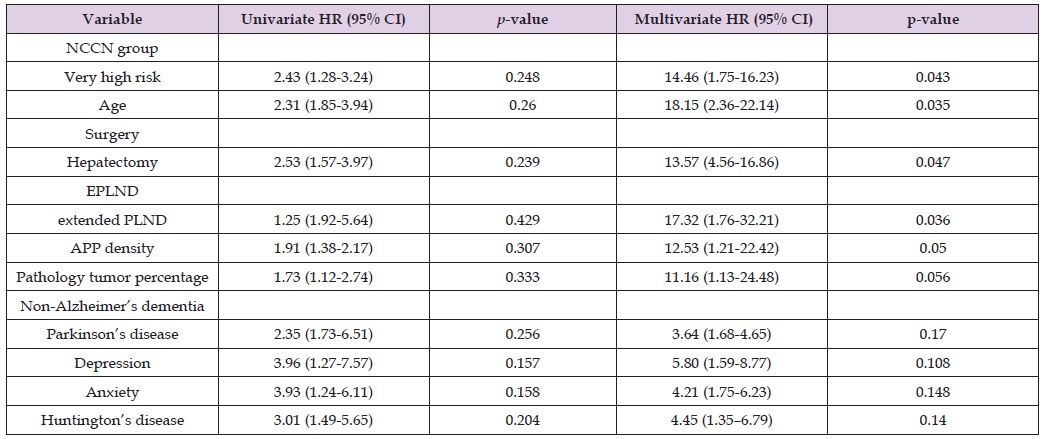
Note: Abbreviations: HR, Hazard ratio; APP, Amyloid-β; CI, Confidence interval; PLND, pelvic lymph node dissection; CT, computed tomography; MRI, magnetic resonance imaging; Hazard Rations with 95% CI from a stratified Cox regression for dementia associated with Alzheimer’s NAFLD cancer patients after operative in the total population. The reference group is the matched cohort under each category. Performed by the student t test. p<0.01, p<0.05 significant values are shown.
Dementia has many causes, but not just Alzheimer’s, and the symptoms of non-Alzheimer’s dementias can be very different. The most common Alzheimer’s disorders cause dementia. According to the 3-year survey data from Jan 2023 to Jan 2026 from the outside health database in Shaoguan City that we tracked, there was a significant difference in the risk of dementia after surgical treatment or medical treatment without surgery for patients diagnosed with Alzheimer’s disease. The main reason is the high prevalence of NAFLD, which allows chronic liver disease to further develop into liver cancer. Dementia resulting from Alzheimer’s disease was difficult to diagnose in the past few years [8]. In this retrospective cohort study, we analyze the data retrospectively to determine whether the risk of Alzheimer’s dementia increases after Alzheimer’s surgery, and to evaluate possible associations between the risk of dementia and Alzheimer’s, NAFLD, and the type of surgery. Alzheimer’s dementia is caused by neurodegeneration, but non-Alzheimer’s dementia is caused by surgery [9]. Dementia is Alzheimer’s disease, the most common case, but the neurodegenerative disorders-induced dementia overlaps with that of surgery-adverse dementia. Underdiagnosis and misdiagnosis of Alzheimer’s dementias and non-Alzheimer’s dementias are key issues. Liver surgery to remove part of the liver in elderly cancer patients, postoperative cognitive dysfunction and dementia [10].
It is important to identify Alzheimer’s or non-Alzheimer’s dementia occurrence. Surgery causes inflammation of nerve tissues led to mental decline [11]. Anesthetics cause a person to lose consciousness by blocking the transmission of information between different areas of the cerebral cortex. Patients who wake up after surgery have cognitive decline or memory loss [12]. NAFLD cancer surgical anesthetics cause temporary dementia risks. Anesthetics for liver cancer surgery tend to increase the risk of dementia rather than Alzheimer’s disease [13]. Alzheimer’s symptoms are a sign of a condition similar to dementia. The signs of Alzheimer’s disease are the difference between the type of dementia and the typical age-related changes [14]. Protein induced by antagonists-2 (PIVKA-2) plays a role in screening and overexpression in HCC cells (Table 1). In the blood of healthy people, the value of PIVKA-2 is about 10-31 mAU/mL, and if it exceeds 31 mAU/mL, it indicates a potential risk of hepatocellular carcinoma or liver cirrhosis. In patients with more than 40 mAU/mL, the correct diagnosis rate of hepatocellular carcinoma was 71.63% [15]. Dementia is a progressive neurodegenerative of Alzheimer’s disease, but sugery has a different dementia than Alzheimer’s disease [16]. The degeneration of disease is not certain; however, nerve cells in the brain are destroyed, and the most obvious early symptoms include memory loss, as well as problems with recognizing time, place, and people.
This is mainly due to the invasion of the hippocampal gyrus and abnormal nerve fiber entanglement [17]. The dysfunction of the blood-brain barrier due to the neuroinflammation induced by NAFLD, which promotes abnormal brain function related to the liver- brain axis [18]. NAFLD and dementia share common risk factors [19]. However, whether Alzheimer’s and non-Alzheimer’s disease are associated with dementia risk is unclear. NAFLD cancer is caused by cirrhosis, and its high-risk factors include dementia (Table 2). It can be explained what causes dementias, NAFLD liver cancer, and Alzheimer’s, and what you can do to try to prevent them [20]. Because no systematic pattern of referral in patients with Alzheimer’s mild cognitive impairment examination findings could be identified, the patients only in the current study had dementia severe cognitive impairment examination findings [21]. Moreover, our analysis was restricted to patients with dementia examination findings as recorded within the entire group. Our dataset did not provide non-Alzheimer’s predictors excluded without sufficient data. Subsequently, we are concerned about the risk of dementia after surgery. Therefore, we hypothesized that it may affect Alzheimer’s and non-Alzheimer ’s-related risk of surgery development of dementia. The dementia hazard ratio for Alzheimer’s after surgery in different older age groups (Table 3). The risks of dementia in different ages after surgery increased Hazard ratio (HR) exponentially compared with the risk who underwent surgery after the age of 70~85.
We found the risk of developing dementia within Alzheimer’s disease. Alzheimer’s disease is the most common type of dementia. There are many non-Alzheimer’s dementia different types and causes of dementia, including Parkinson’s disease, Depression, Anxiety, and Huntington’s disease [23]. The hazard ratio increases for Alzheimer’s cancer after surgery at an elderly age. Dementia underwent surgery more often than in Alzheimer’s dementia. The increased multivariate hazard ratios of dementia were detected in Alzheimer’s liver cancer after surgery in Alzheimer’s liver cancer patients at very high risk and high-risk groups [24]. We found the risk of the development of dementia and Alzheimer’s disease. Alzheimer’s disease is the most common type of dementia [25]. Our data support the hypothesis that exposure to surgery within a year increases the risk of Alzheimer’s dementia development beyond that occurring because of Alzheimer’s exposure to surgery within a year [26]. Many people think that dementia is a normal aging phenomenon in the elderly, and it is different from dementia in people with Alzheimer’s disease [27]. As mentioned above, retrospective data evaluation. However, a prospectively managed register, including reporting of surgery adverse events, reduced these limitations [28]. Furthermore, the retrospective cohorts were heterogeneous. Even though the patients were included consecutively [29]. Clearly, Alzheimer’s dementia is a key issue [30]. Effective Alzheimer’s interventions for dementia. In this retrospective cohort study, we suggest that the risk of Alzheimer’s dementia increases after Alzheimer’s surgery, and at the high risk of dementia, Alzheimer’s, NAFLD, and surgery.
This work was supported by Shaoguan University Grant provided.
The authors declare that they have no conflicts of interest related to this article.
This study was approved by the ethics committee of Shaoguan University. Informed consent was obtained from all the participants. All participant data acquisitions were carried out according to institutional guidelines. All study procedures performed involving human subjects were in accordance with the Declaration of Helsinki.
The data supports the findings of this study are available on request from the corresponding authors.

International Association of Landscape Archaeology, Czech Glass Society, Czech Republic

Department of Chemistry, Semenov Institute of Chemical Physics, USSR Academy of Sciences, Moscow, Russia

Associate Professor at Department of Breast and Thyorid Surgey, Chongqing General Hospital, China

Professor of Nuclear Medicine, Faculty of Medicine and Surgery, University of Milan, Milan, Italy

Department of Pharmaceutical Sciences, South University School of Pharmacy, USA





 Abstract
 PDF
PDF