[email protected]
+1 (502) 904-2126
One Westbrook Corporate Center, Suite 300, Westchester, IL 60154, USA
Site Map
 ISSN: 2574 -1241
ISSN: 2574 -1241
ISSN: 2574 -1241
Received: January 06, 2025; Published: January 13, 2026
*Corresponding author: Abbas Mirshafiey, Department of Immunology, School of Public Health, Tehran University of Medical Sciences, Box: 14155-6446, Tehran, Iran. Livonian Biotech Millennium, Duntes 3, Riga, LV-1013, Latvia Mohadeseh Farokhfar, Department of Neurology, Ramsar Campus, Mazandaran University of Medical Sciences, Ramsar, Iran
DOI: 10.26717/BJSTR.2026.64.010042
Objectives: Multiple sclerosis (MS) is a chronic autoimmune disorder of the central nervous system, characterized
by focal demyelination and axonal damage in the brain and spinal cord. Th1 and Th17 cells play a key role
in MS pathogenesis, and their associated cytokines are considered therapeutic targets in drug development.
However, current treatments often cause widespread side effects. β-D-mannuronic acid (M2000) is a novel immunomodulatory
agent patented under DE-102016113018.4, has demonstrated immunoregulatory and immunosuppressive
properties in previous studies. This study investigates the effects of two different doses of M2000
on the expression of RORC, AHR, T-bet, IL-17, IL-22, and IFN-γ genes in peripheral blood mononuclear cells
(PBMCs) from MS patients.
Methods: Blood samples were collected from twelve relapsing-remitting MS (RRMS) patients aged 20–50 years
and twelve healthy volunteers. PBMCs were treated with two different concentrations of M2000, and gene expression
levels of RORC, AHR, T-bet, IL-17, IL-22, and IFN-γ were quantified using real-time PCR.
Results: M2000 treatment significantly reduced the expression levels of RORC, AHR, T-bet, IL-17, and IL-22 in
PBMCs compared to untreated controls.
Conclusion: These findings suggest that M2000 may serve as a promising immunomodulatory candidate for the
treatment of multiple sclerosis, with potential to modulate key pathogenic pathways.
Keywords: β-D-Mannuronic Acid (M2000); Multiple Sclerosis; Immunomodulation; RORC; AHR; T-bet; IL-17; IL-22
Abbreviations: AHR: Aryl Hydrocarbon Receptor; AS: Ankylosing Spondylitis; G2013: -L-Guluronic Acid; GAPDH: Glyceraldehyde 3-Phosphate Dehydrogenase; GATA3: GATA Binding Protein 3; MS: Multiple Sclerosis; PBMC: Peripheral Blood Mononuclear Cell; RORC: RAR-Related Orphan Receptor C; ROR: RAR-Related Orphan Receptor Gamma; SEM: Standard Error of Mean; SHIP1: Src Homology 2 Domain–Containing Inositol-5-Phosphatase 1; SOCS1: Suppressor of Cytokine Signaling 1; CNS: Central Nervous System; RRMS: Relapsing-Remitting MS; MS: Multiple Sclerosis; PHA: Phytohemagglutinin; cDNA: Complementary DNA; SD: Standard Deviation; EAE: Experimental Autoimmune Encephalomyelitis
Multiple sclerosis (MS) is a chronic autoimmune disease that affects the central nervous system (CNS), leading to focal demyelination, axonal degeneration, and neuroinflammation in the brain and spinal cord. These pathological changes interfere with the transmission of nerve signals between the CNS and peripheral organs, resulting in a wide range of neurological symptoms. Histopathological analysis of MS lesions reveals inflammatory infiltrates predominantly composed of lymphocytes, especially CD4⁺ T helper cells. Among these, Th1 and Th17 subsets play a pivotal role in MS pathogenesis. Th1 cells produce interferon-gamma (IFN- γ), while Th17 cells secrete interleukin-17 (IL-17) and IL-22, contributing to blood-brain barrier disruption, recruitment of inflammatory cells, and direct damage to oligodendrocytes and neurons. Several studies have reported the involvement of myelin-specific Th1 and Th17 cells in the pathogenesis of MS, and these cells and their related cytokines have been regarded as therapeutic targets in the design of therapeutic targets for MS [1-6]. However, the main problem with these existing treatments is their substantial complications, including influenza-like symptoms, flushing, diarrhea, nausea, leukopenia, and depression. Recent studies have emphasized the role of Th17/1 hybrid cells and the imbalance between Th17 and regulatory T cells (Tregs) in driving disease progression, suggesting that transcriptional modulation may offer a more targeted therapeutic approach [7-9].
Transcription factors such as RORC, AHR, and T-bet are central to the differentiation and function of Th17 and Th1 cells. RORC (retinoic acid-related orphan receptor C) is a master regulator of Th17 lineage commitment, while AHR (aryl hydrocarbon receptor) influences IL- 22 production and CNS inflammation. T-bet is essential for Th1 polarization and IFN-γ expression. Dysregulation of these transcriptional pathways has been linked to disease severity and progression in MS patients, making them attractive targets for immunomodulatory interventions. The safety and efficacy of the patented immunomodulatory drug β-D-mannuronic acid (M2000), synthesized from alginate (DE-102016113018.4), have been described in numerous in vitro and in vivo studies across various inflammatory and autoimmune diseases, including rheumatoid arthritis, Alzheimer’s disease, cancer, and multiple sclerosis [10-17]. The results of previous studies on the effects of M2000 on immune cells, cytokines, and signaling pathways in chronic, inflammatory, and autoimmune diseases [18-25] have paved the way for further investigation of this compound in MS. Therefore, in the present study, we evaluate the impact of two different doses of M2000 on the gene expression of RORC, AHR, T-bet, IL-17, IL-22, and IFN-γ in peripheral blood mononuclear cells (PBMCs) derived from MS patients, aiming to elucidate its potential as a safer and more targeted immunosuppressive therapy.
Study Design and Blood Collection
This study aimed to evaluate the effect of β-D-mannuronic acid (M2000) on the gene expression of RORC, AHR, T-bet, IL-17, IL-22, and IFN-γ in peripheral blood mononuclear cells (PBMCs) from patients with multiple sclerosis (MS), compared to untreated cells. The study was conducted at the MS Clinic of Imam Hossein Hospital, Tehran, Iran, and was approved by the Ethics Committee of Tehran University of Medical Sciences. Written informed consent was obtained from all participants prior to sample collection. Heparinized peripheral blood samples were collected from 12 patients diagnosed with relapsing-remitting MS (RRMS) based on the McDonald criteria, aged 20–50 years, who were receiving interferon-β and had experienced at least one relapse within the previous six months. Additionally, blood samples from 12 age-matched healthy volunteers were collected as controls.
PBMC Isolation, Cell Culture, and M2000 Treatment
PBMCs were isolated from whole blood using Ficoll-Paque density gradient centrifugation. Cell viability and counting were assessed using trypan blue exclusion. Cells were cultured in RPMI-1640 medium supplemented with 10% fetal bovine serum, 1% penicillin/streptomycin, 1% L-glutamine, and sodium pyruvate (all reagents from Gibco, USA), and incubated at 37°C in a humidified atmosphere containing 5% CO₂. PBMCs were activated with a brief exposure to phytohemagglutinin (PHA). Only cell suspensions with viability >95% were used for downstream experiments. After 4 hours of incubation, cells from each patient were divided into three wells: one was treated with a low dose of M2000 (5μg/mL), one with a high dose (25μg/mL), and one left untreated as a positive control. PBMCs from healthy individuals served as the negative control group. All cultures were incubated for 18 hours under identical conditions.
RNA Extraction and cDNA Synthesis
Total RNA was extracted from PBMCs using the Hybrid-R™ kit (GeneAll, Korea), following the manufacturer’s instructions. RNA concentration and purity were assessed using a NanoDrop 2000 spectrophotometer. Samples with OD260/280 ratios between 1.8 and 2.2 were considered suitable for cDNA synthesis. Complementary DNA (cDNA) was synthesized using the PrimeScript™ RT reagent kit (Takara Bio) with oligo-dT and random hexamer primers.
Real-Time PCR Analysis
Quantitative real-time PCR was performed using SYBR® Premix Ex Taq™ II (Takara Bio) on an ABI StepOnePlus™ Real-Time PCR System (Applied Biosystems, USA). Each 20μL reaction contained 1μL of cDNA template, 0.4μL ROX reference dye, 10μL SYBR Green master mix, 7.6μL nuclease-free water, and 0.5μL each of forward and reverse primers (Table 1). GAPDH was used as the internal control gene. The thermal cycling conditions were as follows: initial denaturation at 95°C for 30 seconds, followed by 40 cycles of 95°C for 5 seconds and 60°C for 30 seconds, with a final dissociation step at 95°C for 15 seconds.
Table 1: Primer Sequences Used for Real-Time PCR.

Note: F; Forward, R; Reverse.
Statistical Analysis
Statistical analyses were performed using SPSS software version 24. Data were expressed as mean ± standard error of the mean (SEM). For within-group comparisons (treated vs. untreated), paired sample t-tests were used for normally distributed data, and Wilcoxon signedrank tests for non-normal distributions. For between-group comparisons (healthy controls vs. untreated MS patients), independent t-tests and Mann–Whitney U tests were applied accordingly. A p-value < 0.05 was considered statistically significant.
All 12 patients and 12 healthy control volunteers were enrolled in this study. The patient and control groups were matched for sex (p = 1.00) and age (p = 0.55). Each group included 8 women out of 12 participants. The mean age ± standard deviation (SD) was 34.40 ± 7.90 years in the patient group and 32.46 ± 7.35 years in the control group. To assess the impact of two different doses of M2000 on gene expression, PBMCs from MS patients were analyzed for RORC, AHR, T-bet, IL-17, IL-22, and IFN-γ expression. As anticipated, significant differences were observed between the healthy control group and the untreated patient group across all target genes (see Figures 1-6).
Effect of M2000 on Gene Expression of RORC
According to Figure 1, there was a significant difference (P-value = 0.016) between treated with a low dose of M2000 and untreated group. Similarly, a remarkable reduction (P-value = 0.012) can be seen in the gene expression of RORC in cells treated with a high dose of M2000 (mean ± SEM = 0.88 ± 0.26).
Figure 1

Effect of M2000 on Gene Expression of AHR
As can be seen in the Figure 2, it is shown that there was a marked drop in the mean ± SEM of gene expression of AHR in PBMCs of patient group treated with low dose (P-value = 0.008) and high dose (P-value =0.003) of M2000 in comparison with untreated cells.
Figure 2

Effect of M2000 on Gene Expression of T-Bet
The results presented below in Figure 3, indicate that high dose of M2000 is able to significantly (P-value = 0.01) reduce gene expression of T-bet in comparison with untreated PBMCs and low dose of this drug reduced the gene expression of T-bet to a normal level (mean ± SEM =1.91 ± 0.53).
Figure 3

Effect of M2000 on Gene Expression of IL-17
The statistical analyses revealed that the difference between gene expression of IL-17 in the untreated group and treated groups with the low dose (P-value=0.03) and high dose (P-value=0.01) of M2000 were significant. Under the influence of low dose and the high dose of M2000 the mean amount of gene expressions of IL-17 decreased to 5.15 ± 0.67 and 4.59 ± 0.64, respectively (Figure 4).
Figure 4

Effect of M2000 on Gene Expression of IL-22
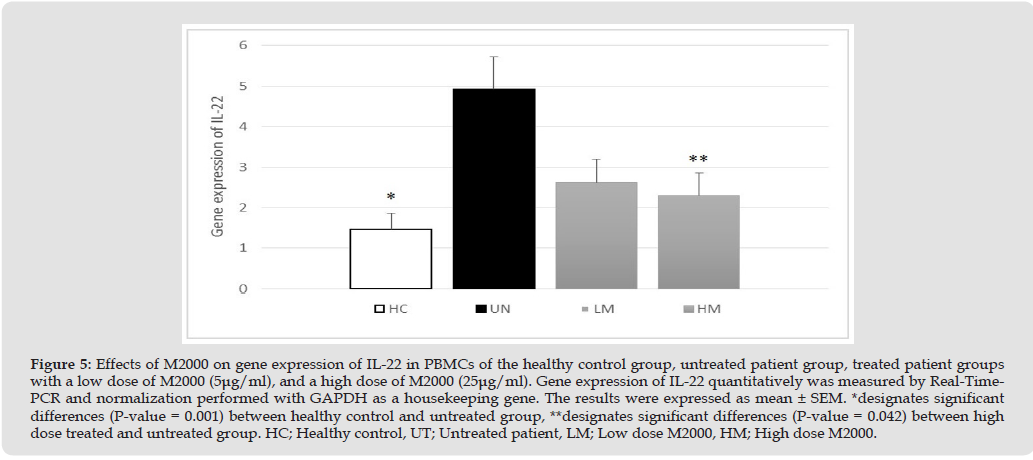
Similar to T-bet, solely a high dose of M2000 was able to significantly decrease the gene expression of IL-22 (P-value = 0.042). The outcome revealed that the level of IL-22 has fallen to 2.63 ± 0.57 (mean ± SEM) at a low dose of M2000 (Figure 5).
Figure 5
Effect of M2000 on Gene Expression of IFN- γ
Treatment of PBMCs with 2 different doses of M2000 did not significantly affect the gene expression of IFN- γ, however there was a small decrease in mean ± SEM of gene expression of IFN- γ in comparison with untreated PBMCs (Figure 6).
Figure 6

The growing interest in the immunopathogenesis of multiple sclerosis (MS) stems from the urgent need to develop therapies that not only modify disease progression but also prevent or potentially cure it. Among the major pathogenic effector cytokines implicated in MS and its animal model, experimental autoimmune encephalomyelitis (EAE), are IL-17, IL-21, IL-22, and IFN-γ—primarily produced by CD4⁺ T cells of the Th17 and Th1 lineages. These cytokines and their cellular sources have thus emerged as promising therapeutic targets [2]. This study aligns with previous investigations on β-D-mannuronic acid (M2000) and its epimer α-L-guluronic acid, which have demonstrated immunomodulatory effects in various in vitro and in vivo models. The anti-inflammatory, apoptotic, chemopreventive, and therapeutic properties of M2000 were first reported by Mirshafiey, et al. in 2004 and 2005 [14,26]. Subsequent studies expanded on these findings, confirming the compound’s efficacy in a range of inflammatory and autoimmune conditions. Notably, Mirshafiey [14,15] reported the therapeutic and prophylactic potential of M2000 in MS with high tolerability [15]. In 2007, the production method of M2000 from alginate and its therapeutic efficacy in experimental glomerulonephritis were described, showing significant reductions in proteinuria and glomerular damage [10]. Toxicological studies by Fattahi et al. confirmed the safety of M2000 in animal models, with no observed mortality or organ toxicity [12]. Further studies demonstrated that M2000 does not adversely affect dendritic cell differentiation or function, nor does it significantly alter the expression of miR-155 and miR-221 in vitro [11,27]. In 2017, in vitro experiments revealed that M2000 acts as an antagonist of TLR2 and TLR4, and modulates key signaling molecules such as SOCS, SHIP, IRAK1, and TRAF6. Clinical trials also showed that M2000 downregulates TLR/NF-κB pathway gene expression in ankylosing spondylitis patients [18,21-23,28]. Mohammed et al. explored the immunosuppressive effects of M2000 on GATA3, IL-4, FOXP3, RORC, TNF-α, and IL-17 in PBMCs from IBD patients. Barati et al. later confirmed that M2000 significantly downregulates IL-17 and RORγt while upregulating IL-4 and GATA3 in RA patients after 12 weeks of treatment. Fattahi et al. also reported that M2000 helps restore Th17/Treg balance in AS patients [19,24,25,29- 33].
Multiple clinical studies have confirmed the beneficial effects of M2000 in chronic inflammatory, rheumatologic, and neoplastic diseases— including RA, AS, atherosclerosis, and breast cancer demonstrating its safety and efficacy compared to conventional or placebo treatments [12,17,20,34]. A recent international, multicenter, randomized, placebo-controlled phase III trial in RA patients with inadequate response to standard therapies showed that M2000 significantly improved joint tenderness, swelling, global disease activity, and pain scores [35]. Recent studies further support the central role of Th17/Th1 cytokines and transcription factors such as RORC, AHR, and T-bet in MS pathogenesis. These factors not only drive inflammation but also disrupt immune tolerance, making them attractive targets for novel immunotherapies [36-38]. In this context, our study evaluated the dose-dependent effects of M2000 on the expression of RORC, AHR, T-bet, IL-17, IL-22, and IFN-γ in PBMCs from RRMS patients. The results demonstrated that M2000 significantly reduced the expression of RORC and AHR at both low and high doses, T-bet at high dose, IL-17 at both doses, and IL-22 at high dose, compared to untreated cells.
This trial highlights the immunoregulatory potential of β-D-mannuronic acid in modulating key pro-inflammatory cytokines (IL-17, IL-22) and transcription factors (RORC, AHR, T-bet) involved in MS pathogenesis. Based on these findings, M2000 may be considered a promising immunomodulatory agent for the treatment of MS and other inflammatory disorders.
Ethical Approval and Consent to Participate
All procedures performed in this study involving human participants were in accordance with the ethical standards of Ethic Committee of Tehran University of Medical Sciences and informed consent was obtained from all individual participants included in the study.
Competing Interest
The authors declare that they have no competing interests.
Consent for Publication
Not applicable.
Availability of Data and Material
All data generated or analyzed during this study are included in this published article and are available in the department of Immunology, School of Public Health, Tehran University of Medical Sciences, Tehran, Iran.
Funding
The author(s) received no financial support for the research, authorship, and publication of this article.
Conflict of Interest
The author (editor) declares no conflict of interest, financial or otherwise.
Acknowledgement
We would be grateful from the MS Clinic at Imam Hossein Hospital for facilitating this study. We sincerely thank all participants for their cooperation and contribution in this research.

International Association of Landscape Archaeology, Czech Glass Society, Czech Republic

Department of Chemistry, Semenov Institute of Chemical Physics, USSR Academy of Sciences, Moscow, Russia

Pharmaco-kinetics, dynamics and Drug Metabolism, Touro College of Pharmacy, USA

Professor of Nuclear Medicine, Faculty of Medicine and Surgery, University of Milan, Milan, Italy

Clinical Radiologist (MD) - Department of RADIOLOGY, Cosenza Hospital, Cosenza, Italy





 Abstract
 PDF
PDF